
Reviewed · MARRAKECH TOURS
Marrakech: Saadian Tombs & Bahia Palace, Medina Guided Tour
Marrakech reveals itself best on foot, and this four-hour route moves from the grand Koutoubia minaret into royal tombs, palace courtyards, the old Jewish quarter, and narrow souk lanes. Abdul, Ahmed, Rashid, and other local guides bring the sites to life with stories about Moroccan history, Islam, architecture, and daily life.
I like the tour’s strong first-day value: for $18, you get a local guide and a useful orientation to the medina. I also like the chance to choose a private outing or shared group, with guides often allowing time for photos, questions, rest, and small changes to the pace.
The catch is simple but important: entry to the Saadian Tombs and Bahia Palace costs another 200 MAD per person in total, paid in cash. Lines can also be long at the tombs, especially for the small main chamber, so you may need to decide between waiting and moving on.
Key Points Before You Book
- The route links six major areas: Koutoubia Mosque, Bab Agnaou, the Kasba, Saadian Tombs, Mellah, and Bahia Palace.
- The $18 price excludes admission: Budget 100 MAD for Bahia Palace and 100 MAD for the Saadian Tombs.
- The meeting point is central: Shared tours and walking tours without pickup begin in front of Café de France on Jemaa el-Fnaa.
- The guides get high marks for personality: Abdul is often praised for humor and clear explanations, while Ahmed, Rashid, Mohammed, Rachid, and others are also named as friendly local guides.
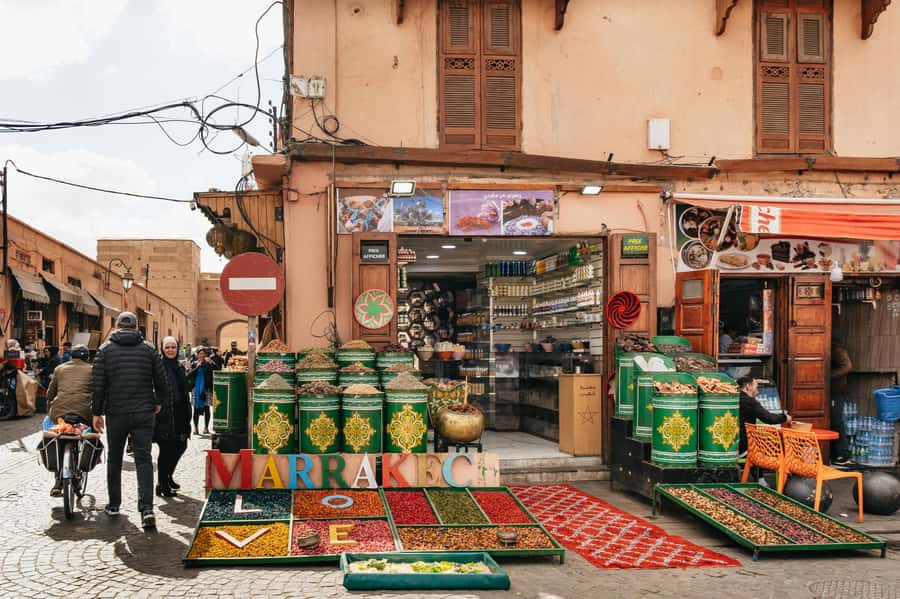
- The souks are part of the lesson: You see tinsmiths, dyers, herbalists, craft workshops, and stalls, with practical advice about shopping.
- The tour is a real walk: Wear firm shoes, carry water and sunglasses, and expect uneven paths, narrow lanes, heat, and crowds.
Why This Four-Hour Walk Works as a Marrakech Introduction
Marrakech can feel like a puzzle on your first day. Jemaa el-Fnaa is easy to find, but the medina quickly turns into a web of lanes, workshops, courtyards, shrines, and market streets. A local guide gives you a map in your head before you try exploring alone.
The route is also well balanced. You are not spending four hours on one palace or marching from monument to monument without context. Instead, you get a look at religious architecture, royal power, burial customs, neighborhood life, and trade.
I would book this early in a Marrakech stay. By the end, you should have a better sense of the old city, the main southern sights, and the souks. You can then return to the places that caught your interest at your own pace.
The experience is offered as a shared group or private tour. A private option is the better choice if you want to ask many questions, move slowly, or adjust the route. A shared group costs less and can be more sociable, but the pace may need to suit several people.
Some departures include hotel or riad pickup by van, but only if you select the private tour with hotel pickup option. A walking tour without pickup begins in front of Café de France, an easy landmark on Jemaa el-Fnaa Square.
A few other Marrakesh days worth comparing
- Marrakech: Bahia Palace, Saadian Tombs, Souk and Medina Tour
★ 4.7 · 4,974 reviews - Marrakech: Ben Youssef, Secret Garden, & Souks Walking Tour
★ 4.6 · 2,802 reviews - Marrakech: Colorful Medina Souks Guided Walking Tour
★ 4.7 · 2,470 reviews
Starting at Jemaa el-Fnaa and Koutoubia Mosque
Begin at Café de France, where the city’s main square serves as both meeting point and orientation board. Jemaa el-Fnaa changes throughout the day, but it is always a useful place to understand Marrakech’s public life.
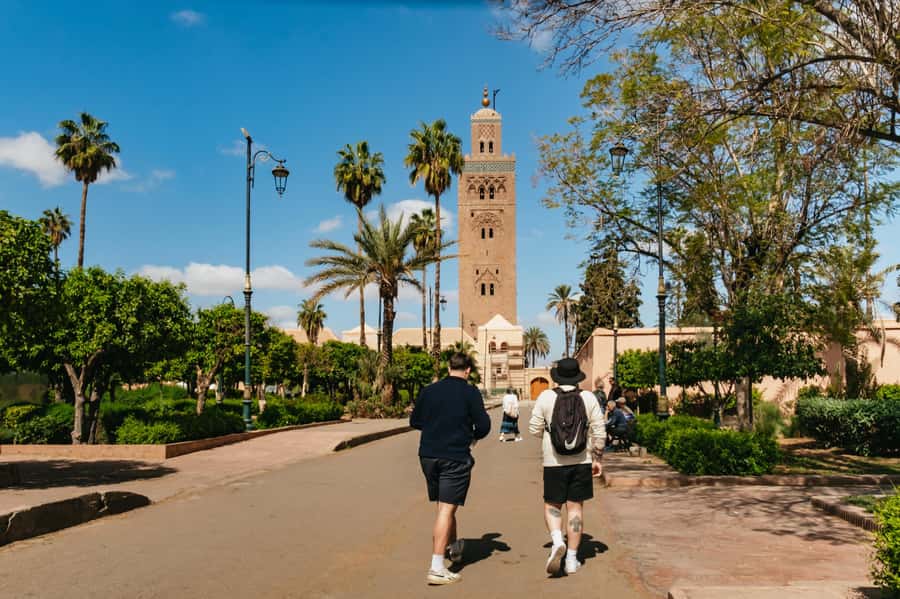
Your guide should help you get comfortable with the movement around the square before leading you toward Koutoubia Mosque. The mosque is one of the city’s clearest reference points, thanks to its tall minaret, described here as the largest in Marrakech and the tallest in Morocco.
The Koutoubia stop lasts about 30 minutes. You learn about the mosque’s design, history, and place in the city. The tour focuses on the exterior, since non-Muslim visitors cannot enter the mosque itself.
This is a good early stop because the minaret gives you a visual anchor. Once you leave the square, the medina can feel confusing. Knowing where Koutoubia sits in relation to Jemaa el-Fnaa makes later wandering easier.
Bring water even in cooler months. Several people found the walk hot, and the route does not become easier simply because the streets are shaded.
Bab Agnaou, the Kasba, and a Royal Entrance
Next comes Bab Agnaou, one of Marrakech’s notable historic gates. The stop is short, about 10 minutes, but it adds useful context to the southern part of the old city.
Bab Agnaou is not treated as a full museum visit here. Expect a guided look, photographs, and an explanation of its role as an entrance into the Kasba area. The value is in seeing how the city’s walls, gates, and royal districts fit together.
The Kasba stop lasts around 20 minutes. This part of the walk shifts from monumental architecture to the texture of the old quarter. Your guide can explain how the area connects to the royal sites ahead, while you move through lanes that are far less open than Jemaa el-Fnaa.
Keep your group close in the Kasba. Narrow passages, scooters, pedestrians, and sudden turns are normal. A guide is especially useful here because you can concentrate on the buildings instead of constantly checking your route.
The Saadian Tombs and the Famous Queue
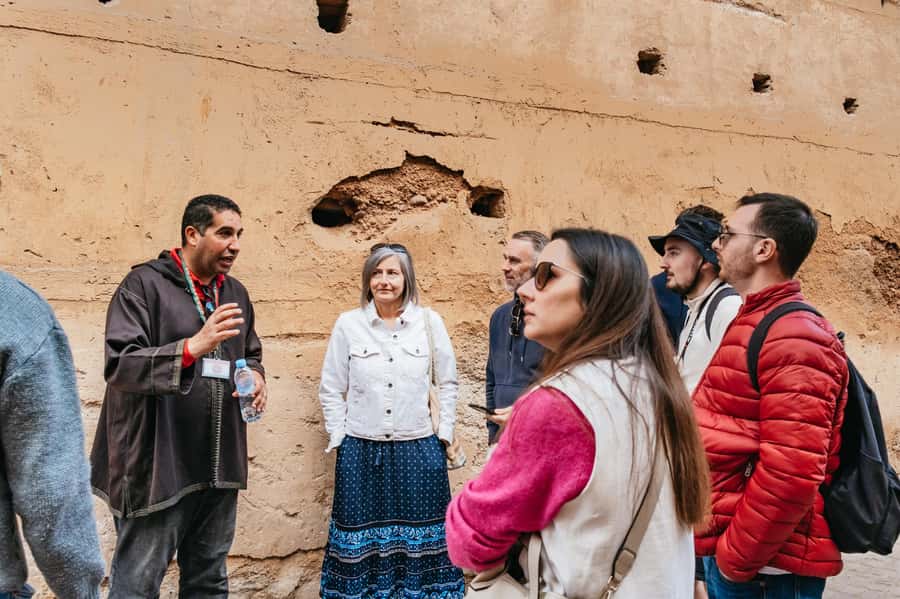
The Saadian Tombs are one of the tour’s main historical stops. They were sealed for centuries and rediscovered in 1917, preserving ornate burial spaces connected with a 16th-century royal family.
The carved decoration reflects a Hispano-Moorish style, with careful geometric work and fine surface detail. This is a compact site, not a vast complex, but it rewards close attention. The guide’s explanation matters because the meaning of the rooms and the royal connections are not always obvious from a quick look.
The planned visit lasts about 40 minutes and includes free time for photographs. The practical problem is crowding. The small chamber often associated with the most elaborate decoration can develop a long queue, sometimes around 45 minutes.
That wait changes the value calculation. If you have paid 100 MAD and want to see every detail, waiting may be worthwhile. If you prefer a moving tour, your guide may offer the group a choice: wait, skip the interior, or return later on your own.
This flexibility is one of the tour’s better features. Some groups have chosen not to wait, while still receiving the historical explanation and seeing the surrounding area. You are not locked into standing in line simply because the site appears on the schedule.
Bring cash in Moroccan dirhams. The admission fee is not part of the $18 tour price, and payment is made on-site.
Same city, a completely different day out:
- Marrakech: Agafay Desert Sunset, Camel Ride, and Dinner Show
★ 4.6 · 35,119 reviews - From Marrakech: Ouzoud Waterfalls Guided Hike and Boat Trip
★ 4.7 · 33,630 reviews - Marrakech: Agafay Desert Quad & Camel Rides with Dinner Show
★ 4.8 · 27,382 reviews - Marrakech: Agafay Desert Quad Biking Tour with Dinner-Show
★ 4.8 · 16,569 reviews
Mellah: A Short Stop with Useful Context
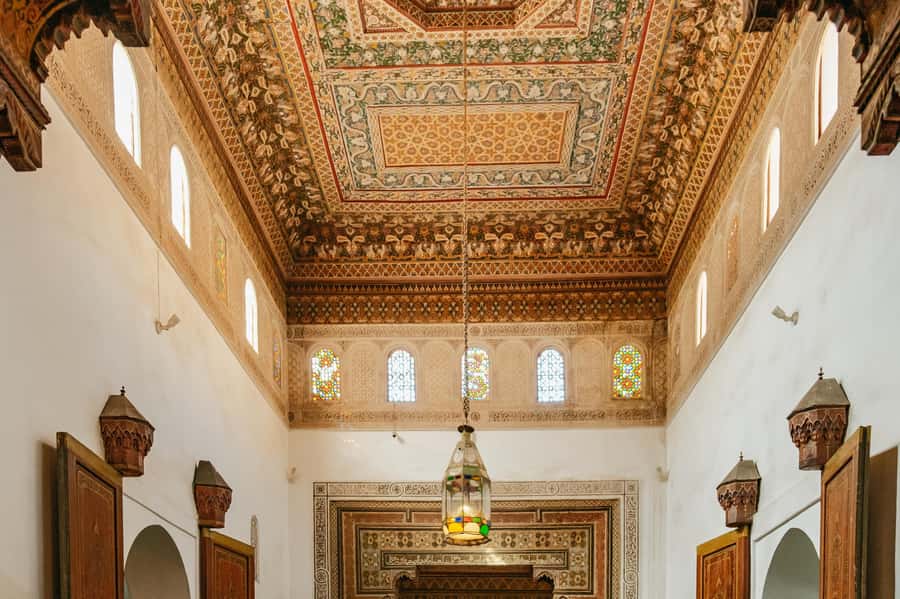
The route then reaches Mellah, the former Jewish quarter of Marrakech. The scheduled stop is about 10 minutes, so this is more of a guided orientation than a long neighborhood visit.
That brief pause still helps explain the city’s layered past. You see how different communities and districts were organized within the old city, and your guide can connect Mellah to the broader story of Marrakech.
Do not expect a separate museum visit or an extended walk through every street. The stop works as a bridge between the tombs and Bahia Palace, giving the palace a clearer setting within the southern medina.
Bahia Palace’s Painted Ceilings and Garden Rooms
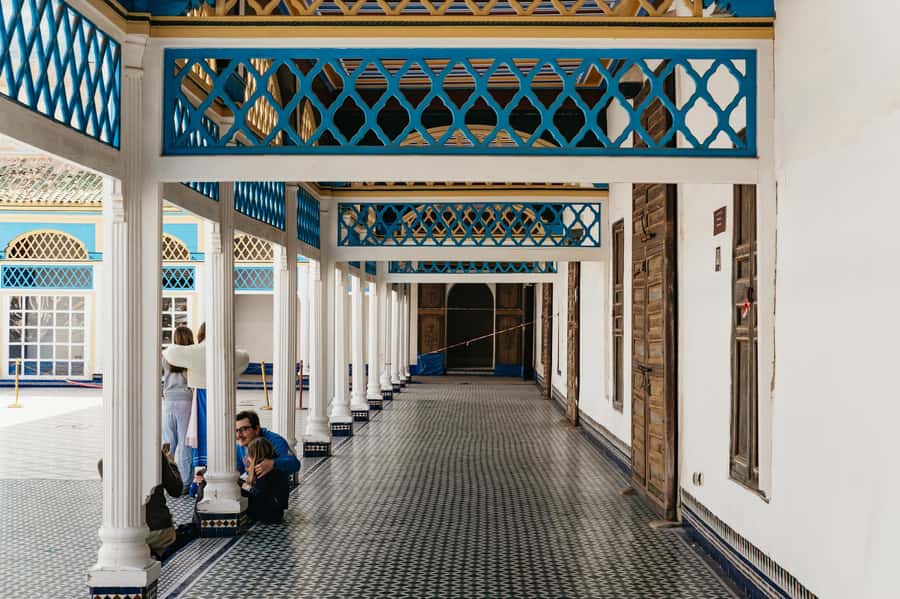
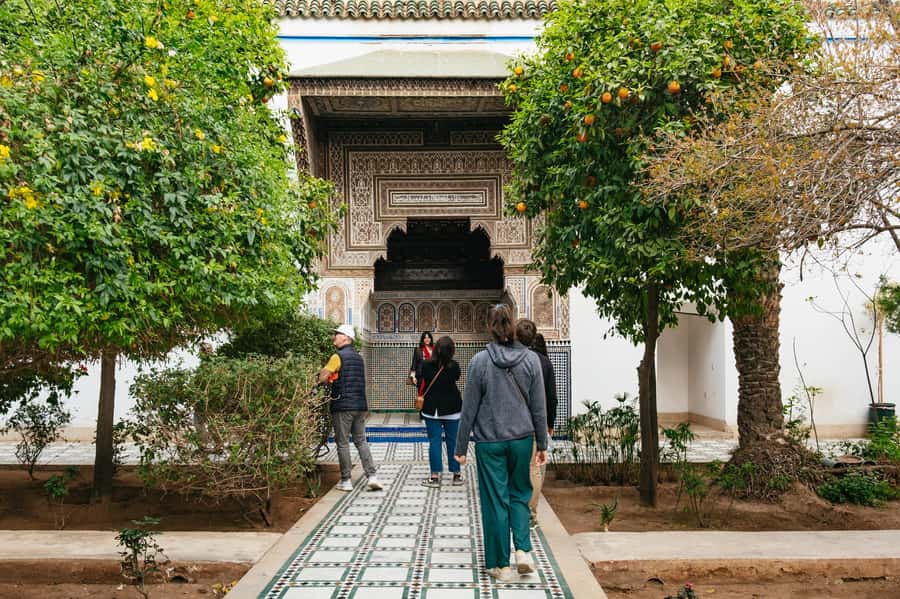
Bahia Palace receives the longest stop, about one hour, and rightly so. This 19th-century royal residence was intended to be one of the finest palaces of its day.
The palace is built around courtyards and rooms decorated with painted ceilings, carved stucco, patterned tilework, and gardens with fruit trees. Much of the pleasure comes from looking up and around. The surfaces are busy, but a good guide helps you notice repeated forms, craftsmanship, and the way the rooms open toward courtyards.
Bahia is not a furnished royal home in the way some European palaces are. Its appeal comes from architecture, decoration, proportion, and the contrast between shaded rooms and planted courtyards.
Your guide’s pacing matters here. Several guides, including Abdul, are praised for giving people time to take photos rather than rushing from room to room. You should have a guided explanation followed by moments to look around independently.
The palace admission fee is another 100 MAD per adult. Add it to the 100 MAD tomb fee when working out the true cost of the tour.
Bahia Palace can be crowded, particularly later in the day. The narrow rooms and courtyards may feel packed at busy times, so an early start can make the visit more comfortable. Still, the site remains one of the strongest reasons to choose this route.
The Souks and the Art of Not Buying Everything
The final stretch takes you through Marrakech’s souks. This is where the tour becomes less about fixed monuments and more about how the medina works.
You may pass tinsmiths, dyers, herbalists, and other craftspeople in small workshops or stalls. The point is not simply to browse. Your guide can explain what different artisans make and offer tips on finding suitable stalls.
That advice can save time and reduce stress, especially if you are new to Moroccan markets. The souks are energetic and crowded, and shopkeepers may invite you to look. You should feel free to browse without buying, but it helps to understand that bargaining is part of the shopping culture.
One caution: some versions of the route may include a stop at a herbal treatment shop. The display of herbs, spices, and traditional products can be interesting, but it may also lead to a chance to buy something. The extra stop has been described as informative, with no pressure to purchase, yet you should know it can take roughly 30 to 40 minutes and may extend the tour.
If shopping is not your priority, tell your guide early. The strongest part of this experience is its focus on history and culture, not turning the whole afternoon into a sales circuit.
The walk finishes back at Jemaa el-Fnaa. This is a useful ending because you can stay in the square for storytellers, musicians, and performers, or use the location to continue exploring.
The Guides Make the Difference
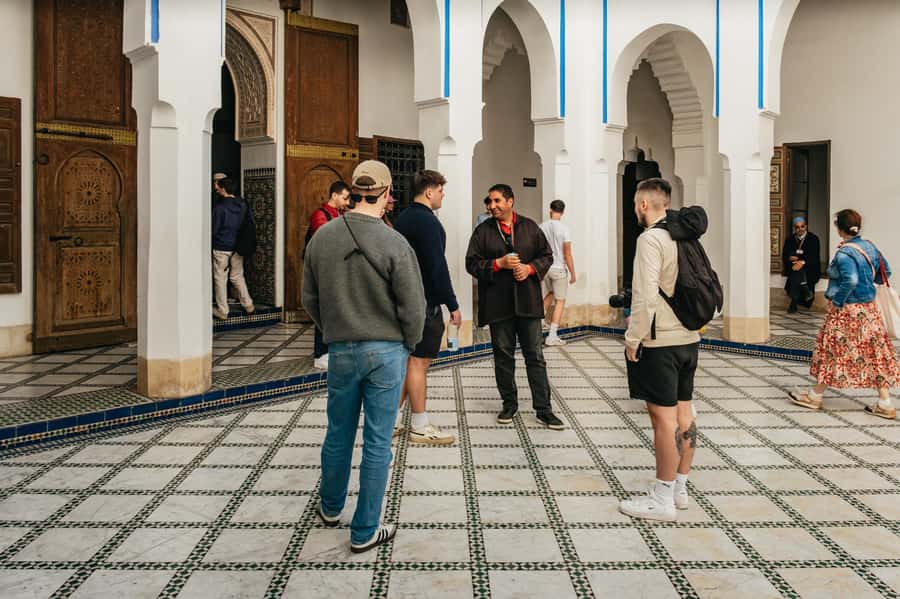
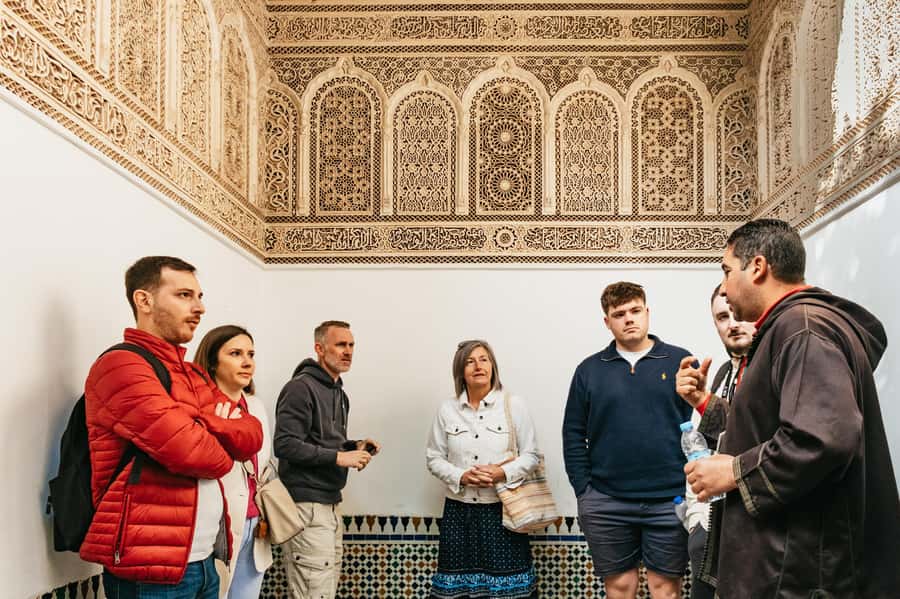
The guide is the main variable in a walking tour, and this one has a strong record for friendly, engaging leadership. Abdul is repeatedly praised for his humor, patience, and ability to explain Moroccan history, culture, and Islam in clear terms.
Other named guides include Ahmed, Rashid, Mohammed, Rachid, Mo, Bader, Izmael, Shafiq, and Abdellah. The useful pattern is not one single personality, but the guide’s role in making a complicated city easier to understand.
You should expect more than dates and architectural labels. Guides may discuss religious practice, cultural customs, language, local plants and minerals, artistic symbols, and the reasons certain buildings matter.
Good guides also manage practical needs. Abdul is praised for allowing rest, bathroom breaks, photographs, and questions. That matters on a four-hour walk, especially in summer or with children.
Families can take the tour, and one family managed it with a double buggy and two toddlers. Still, the medina’s narrow alleys and uneven paths can make a stroller awkward. Children must remain with an adult, and anyone with limited mobility should consider the route carefully despite the activity being marked wheelchair accessible.
What the $18 Price Really Buys You
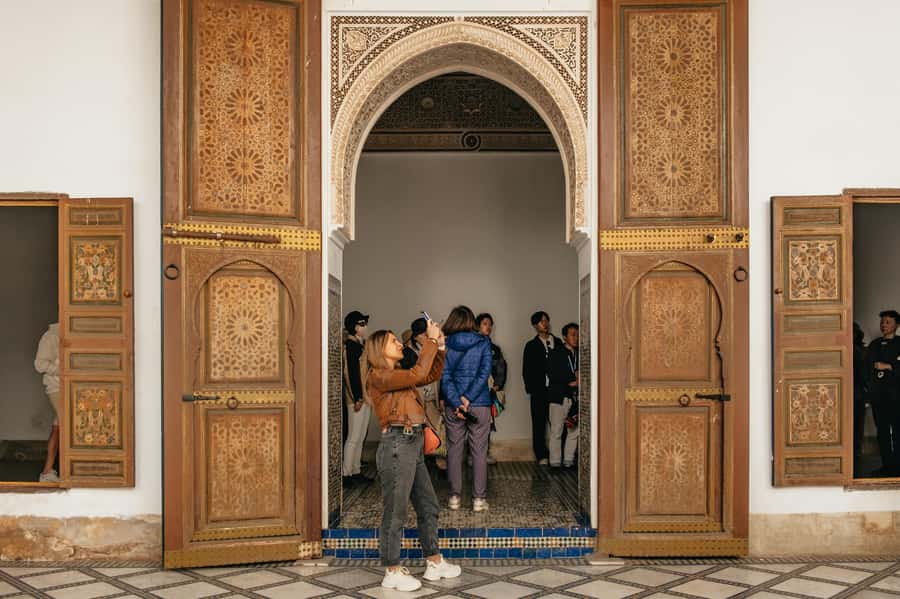
At $18 per person, the tour is inexpensive for a four-hour guided introduction. The price pays for a licensed local guide, route planning, explanations at several major sites, and help finding your way through the medina.
The real cost is higher if you enter both paid monuments. Add 100 MAD for Bahia Palace and 100 MAD for the Saadian Tombs, or about $20 in total based on the supplied conversion. You should also carry extra dirhams for water, snacks, and small purchases.
The skip-the-line benefit helps at selected monuments, but it does not remove the need to pay admission. It also cannot guarantee a completely empty site. The Saadian Tombs queue can still affect your choices, especially at the most ornate room.
For a private tour, the value improves if you are traveling with several people and care about pace or personal questions. For solo visitors and couples, the shared option gives you a lower-cost introduction, though you have less control over timing.
The tour lasts four hours in the schedule, but it may run longer if the group starts late, spends extra time at a site, or visits a herbal shop. One private tour took about three hours, while another ran beyond the advertised time. Allow a little breathing room before your next plan.
Practical Advice for a Better Walk
Wear shoes with solid soles. The route includes narrow lanes, uneven surfaces, and a lot of standing. Sandals may be fine for some people, but comfortable walking shoes are the safer choice.
Carry water, sunglasses, and cash. The sun can be strong, and cash is needed for the two entrance fees. Dress for the season, since the tour runs in rain or sunshine.
Confirm the meeting details when you book. Shared tours and private walking tours without pickup meet at Café de France in Jemaa el-Fnaa, while hotel or riad pickup is included only with the private van option.
If you choose pickup, the driver contacts you on WhatsApp about 10 minutes before the start. The driver waits at the main entrance or reception, then takes you to the meeting point to meet the licensed guide.
Languages include Arabic, English, French, German, Spanish, and Italian. Cancellation is free up to 24 hours before the start, and you can reserve now and pay later.
Who Should Book This Tour?
I would choose this tour if you are new to Marrakech, want the major southern monuments explained, or feel unsure about navigating the medina alone. It also suits solo visitors who want a friendly first outing and families who need a guide willing to pause.
History and architecture fans should pay for both monuments if the lines are reasonable. If you dislike queues, visit the Saadian Tombs separately at a quieter time and use the tour for the guide’s explanation and the other stops.
This is less suitable if you want a slow, highly specialized palace tour, a food walk, or a shopping-only experience. It covers a lot of ground and gives you a broad introduction rather than a narrow study of one subject.
Should You Book the Marrakech Medina Walk?
Yes, for most first-time visitors. The route gives you Koutoubia Mosque, Bab Agnaou, the Kasba, Saadian Tombs, Mellah, Bahia Palace, and the souks in one practical half-day.
Book it early in your stay, bring the extra 200 MAD if you want both paid sites, and ask about queue conditions at the tombs. At $18 before admissions, it offers a useful mix of orientation, history, and local guidance, with enough flexibility to keep the walk from feeling like a forced march.
FAQ
Where does the walking tour meet?
If you book a shared group tour or a private walking tour without hotel pickup, meet in front of Café de France on Jemaa el-Fnaa Square. The exact meeting point can vary with the selected option.
Are Bahia Palace and the Saadian Tombs included in the price?
No. Admission costs 100 MAD per adult at Bahia Palace and 100 MAD per adult at the Saadian Tombs. Pay these fees in cash on-site.
How long does the tour last?
The scheduled duration is four hours. The actual time may vary if the group starts late, spends longer at a site, or includes a stop at a herbal treatment shop.
Is hotel or riad pickup available?
Pickup is available only if you select the private tour with hotel pickup by van. Shared tours and private walking tours without pickup meet at Café de France.
What languages are offered?
The licensed local guides offer Arabic, English, French, German, Spanish, and Italian.
Is the tour suitable for wheelchair users?
The activity is marked wheelchair accessible, but the medina has narrow alleys, uneven paths, and busy souks. These conditions may not suit wheelchair users or people with limited mobility.
What should I bring?
Bring comfortable shoes, sunglasses, water, and cash. You need Moroccan dirhams for the monument entrance fees and small personal expenses.
Just listed out of Marrakesh
- Marrakech: Ouzoud Waterfalls Trip, Guide & Boat + Lunch★ 4.7 · 33 reviews
- Marrakech: Vibrant Dinner Show at The Lotus Club★ 3.9 · 33 reviews
- From Marrakech: Small Group To Essaouira & Medina Day Trip★ 4.3 · 33 reviews
- From Marrakech: 3-Day Merzouga and Sahara Desert Tour★ 4.5 · 33 reviews
- Marrakech: Private Souks Tour with Tea and Traditional Snack★ 4.6 · 33 reviews
- Marrakech: Medina Souks, Hidden Markets and Shopping Tour★ 4.8 · 33 reviews
- 2 Days Desert Agafay and Atlas Mountains Trek From Marrakech★ 3.8 · 33 reviews
- Agadir/Taghazout : Marrakech Guided Tour old Medina & Souks★ 3.7 · 34 reviews
Marrakech Tours, compared.

Agafay Desert Sunset, Camel Ride, and Dinner Show
Read our review →
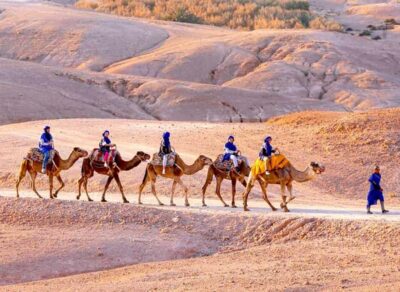
Agafay Desert Quad & Camel Rides with Dinner Show
Read our review →
Agafay Desert Quad Biking Tour with Dinner-Show
Read our review →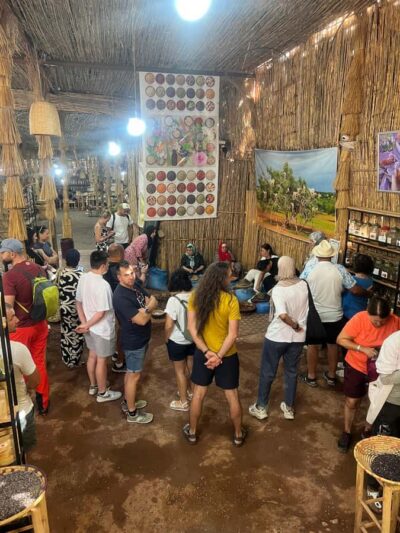
Atlas Mountains, Ourika Valley, Waterfall & Lunch
Read our review →

Quad Bike Tour to Palm Oasis and Jbilat Desert
Read our review →Browse the lists this tour appears in