
Reviewed · MARRAKECH TOURS
The 10 Tastings of Marrakech With Locals: Private Food Tour
The best part of this Marrakech food walk is that you do more than eat. You watch warka pastry being made, choose dates and olives in the market, and sit down to tanjia, the slow-cooked meat dish associated with Marrakech. The food gives you a practical way into the medina, one bite at a time.
I like the private format, since guides such as Houssain, Aimad, Ismael, Hassan, Omar, and Adil have been praised for adapting to families, answering questions, and finding food that suits different tastes. I also like the range: small sweets, salads, juice, olives, kofta, tanjia, mint tea, and more.
The main thing to consider is guide consistency. Most experiences are warm and well paced, but a few accounts describe rushed walking, weak storytelling, missed preferences, or a private group being combined with another group. At $93.05 per person, you are paying for the guide and access to local food stops, not just ten cheap samples.
Key points to know before you book
- Tanjia is the main event: Marrakech’s signature slow-cooked meat comes near the end, at a discreet food stop.
- The tour is genuinely private on paper: Your group should have only your party and one local guide.
- You see food being made: The warka demonstration adds useful context beyond simply eating.
- The tastings are small but plentiful: Several samples are modest, yet the full four-hour outing can leave you quite full.
- The route mixes food with landmarks: You pass the Mellah, Jemaa el-Fnaa, El Badi Palace, and Koutoubia Mosque.
- Ask for your needs at booking: Vegetarian alternatives and other dietary adjustments are offered, but preferences should be stated in advance.
Why a Marrakech food walk works so well
Marrakech can be hard to read at first. The medina’s lanes twist, the souks blur together, and menus do not always explain what you are ordering. A food guide gives you a reason to stop, look, ask, and taste instead of simply wandering past.
This four-hour outing begins at Tinsmiths Square, also called Place des Ferblantiers. From there, you move through the old center and food markets, with city sights placed between eating stops. The route is less about formal sightseeing than it is about seeing how food fits into daily life.
That distinction matters. You are not signing up for a museum-heavy history tour with a snack at the end. You are signing up to eat your way through the medina, with short cultural pauses and a guide who can explain what is on the plate.
The private arrangement is a real advantage for couples, families, and small groups. You can ask why a dish is prepared a certain way, tell the guide what you do or do not eat, and slow down when a market stall catches your eye. Families have especially benefited from guides adjusting samples for children.
A few other Marrakech days worth comparing
- From Marrakech: Merzouga 3-Day Desert Safari with Food
★ 4.7 · 12,232 reviews - Marrakech: Street Food Tour by Night
★ 4.8 · 2,838 reviews - 3-Day Tour to Merzouga Erg Chebbi with Food & Camel Trek
★ 5.0 · 1,770 reviews
Starting with warka in the Mellah
The first stop is in the Mellah, Marrakech’s historic Jewish quarter, where you learn how warka is made. There is no tasting here, but the demonstration helps you understand the thin pastry used in many Moroccan sweets and savory dishes.
Warka is made with a remarkably delicate batter and careful handwork. The value of this stop is visual: you see the skill behind a food that might otherwise arrive at your table as just another crisp layer.
Do not expect a long formal visit. The listed time is about 20 minutes, and the stop is focused on the pastry-making process. If you want more history about the Mellah, ask your guide directly. The quality of the explanation can depend heavily on who leads your tour.
Almond pastries and the first sweet bite
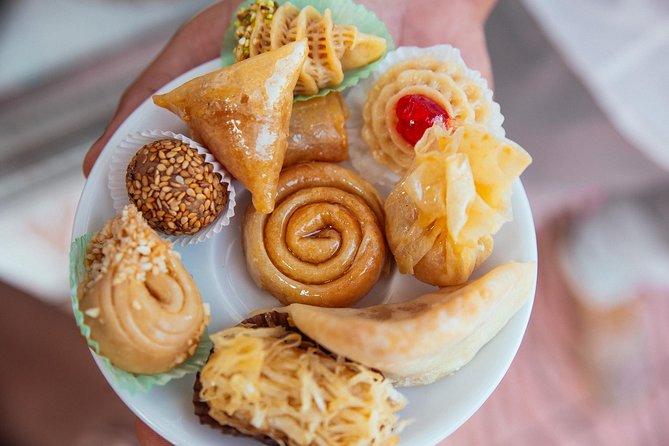
Near Mennconcept, the tour starts tasting with traditional pastries filled with almond. This is a sensible opening. Moroccan sweets can be rich, so beginning with a small portion lets you enjoy the flavor without filling up too soon.
A local bakery also gives you a more useful setting than a packaged hotel pastry. You can see where the food is made and get a feel for how ordinary bakery stops fit into the medina.
The tasting is included, as are all ten food and drink samples. Extra purchases are not included, so keep that in mind if you find a pastry you want to take away.
Dates at Rahba Kedima Square
Rahba Kedima Square is a good place to see the sheer variety of dates sold in Marrakech. You can look over the piles, choose a mix, and decide which types you prefer.
This is one of the more interactive stops. Instead of being handed a fixed sample, you have some choice. Dates are an important part of Moroccan hospitality and daily eating, so the stop offers a simple lesson in local taste without turning into a lecture.
The square can feel crowded and hectic, and the route involves walking through active market lanes. Wear shoes that can handle uneven ground, and stay close to your guide if the group gets separated.
Same city, a completely different day out:
- Marrakech: Agafay Desert Sunset, Camel Ride, and Dinner Show
★ 4.6 · 35,119 reviews - From Marrakech: Ouzoud Waterfalls Guided Hike and Boat Trip
★ 4.7 · 33,630 reviews - Marrakech: Agafay Desert Quad & Camel Rides with Dinner Show
★ 4.8 · 27,382 reviews - Marrakech: Agafay Desert Quad Biking Tour with Dinner-Show
★ 4.8 · 16,569 reviews
Three Moroccan salads above the souks
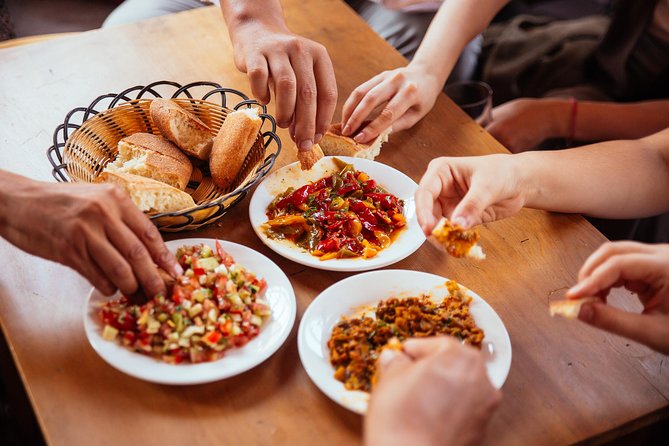
At a café near the History of Kaftan, you taste three styles of Moroccan salad while looking down over the souk streets from a rooftop. These salads are usually vegetable based and seasoned rather than lettuce centered, giving you a clearer sense of how Moroccan meals build flavor through cooked vegetables, herbs, spices, and oil.
I like this pause because it gives your feet a break while adding a view. It also puts the salads in a meal setting rather than presenting them as isolated samples.
The stop lasts around 30 minutes. The café setting may feel more polished than the market stalls, so this is not the most rugged part of the food walk. Still, it adds comfort and makes the route easier for families or anyone who needs a seated break.
Almond or avocado juice on the dry-fruit street
Near the Museum of La Koutoubia, you stop for fresh almond juice or avocado juice while watching trade on the dry-fruit street. These drinks are filling, creamy, and quite different from the mint tea that appears later.
This is a useful place to tell your guide what you prefer. Almond juice offers a distinctly Moroccan flavor, while avocado juice is a familiar fruit drink in a local form. Since the drink is part of the included tastings, you do not need to order an extra beverage unless you want one.
The stop is about 20 minutes, enough time to drink and observe. The description names the museum as a nearby reference point, but the food stop itself is the focus, not a full museum visit.
Olives chosen to your own taste
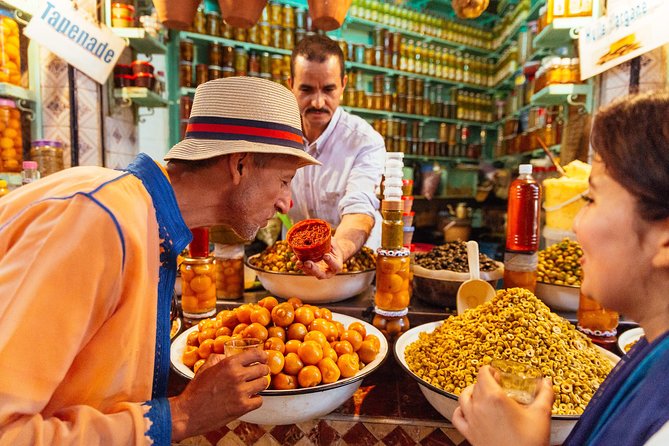
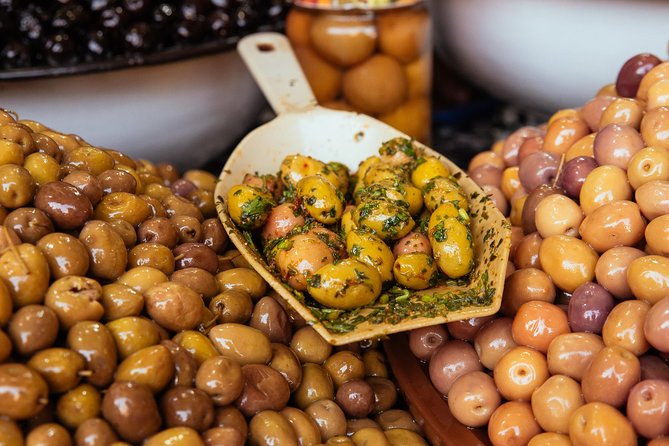
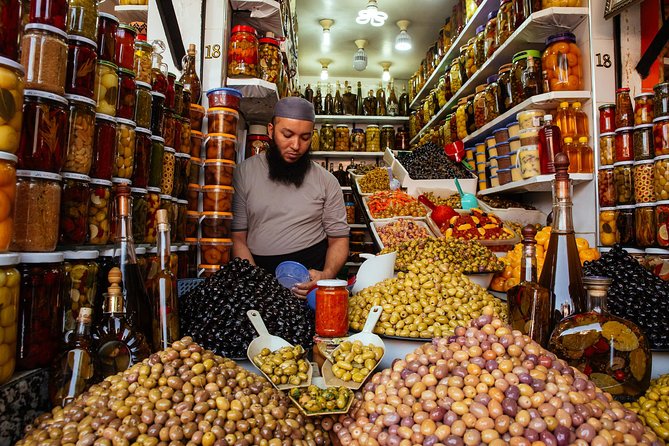
The food markets bring one of the easiest stops to enjoy: olives. You follow the smell of olive oil to a stall or shop, then select flavors and try different varieties.
This is exactly the kind of tasting that is difficult to manage on a first visit. You may recognize green and black olives, but the range of seasoning and preparation can be much broader than expected. Your guide can help you compare the choices and point out what locals commonly buy.
The olive tasting is also a good palate reset after the sweets and juice. It is a market stop, though, not a sit-down meal. Expect to stand, watch the stall activity, and move on after about 30 minutes.
Kofta near Jemaa el-Fnaa
At or near Jemaa el-Fnaa, the menu turns to meat. You try Moroccan kofta, or seasoned meatballs, served with homemade tomato sauce.
This stop gives you one of the clearest examples of everyday Moroccan comfort food. The portion is likely to be smaller than a full restaurant meal, but the food tour as a whole is designed around repeated samples, not ten large plates.
Jemaa el-Fnaa is also one of the places where the pace matters. The square and surrounding lanes can be confusing, and one negative account described a guide marching ahead without enough explanation. A private tour should allow you to ask for a slower pace, especially if you are with children or need time to take photographs.
Tanjia, Marrakech’s signature dish
The tanjia stop is the strongest reason to choose this tour over a generic market snack walk. Tanjia is associated with Marrakech and consists of meat cooked slowly until tender, with the method producing a soft, deeply seasoned result.
The dish is presented as the queen of the menu, and that is fair. Several positive accounts single it out as the best food of the day, while others describe a satisfying meal near the end of the route. This is where the tour shifts from tasting bites to something more substantial.
The location is described as a secret place nearby, rather than a named restaurant. That may be part of the appeal, but it also means you should not expect a polished dining room or a formal culinary presentation. You are there for the dish and the local setting.
One practical note concerns timing. The guide may need to pause for prayer depending on the day and schedule. One account says this happened during a meal and did not cause a problem because the group was seated and eating. If your tour falls on a Friday or you have a firm appointment afterward, confirm the timing at the start.
Mint tea in a beautiful riad
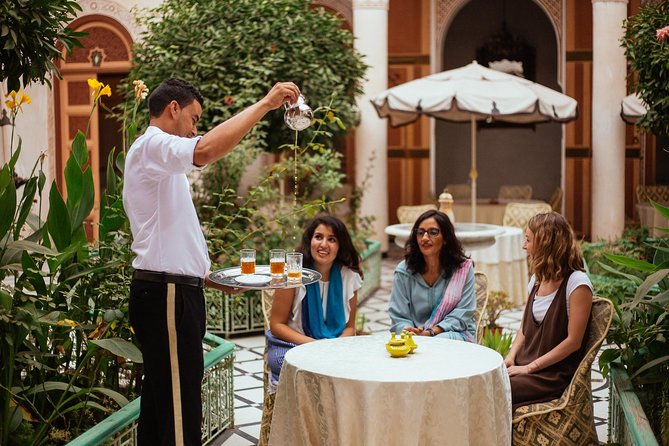
The tour ends with mint tea and cookies in a riad near the Boucharouite Museum. This is a calmer finish after several hours in the market lanes.
A riad can be as memorable as the food. These traditional homes are built around an interior courtyard, often with tiled surfaces, carved details, and quiet rooms that feel far removed from the souks outside. The tea stop gives you time to sit, digest, and ask for further suggestions about Marrakech.
The cookies are a small final sweet rather than a full dessert course. By this point, you may be grateful that the portion is modest.
The landmarks between the plates
The route includes short pauses near El Badi Palace and Koutoubia Mosque. El Badi is a ruined royal palace, while Koutoubia is Marrakech’s largest mosque and one of the city’s major visual markers.
These stops help you orient yourself in the old city, but they are not full guided visits. The listed times are about 15 minutes at each, and admission is free. You should not book this food tour expecting extended access, detailed architectural study, or a replacement for a dedicated city tour.
Still, the combination works. Food gives you a reason to cross the medina, and the landmarks help turn a series of snacks into a clearer picture of Marrakech.
How much food do you really get?
The ten tastings include food and drinks, but each sample is not a full meal. The route includes almond pastries, dates, three Moroccan salads, almond or avocado juice, olives, kofta, tanjia, mint tea, cookies, and the warka demonstration, with the exact count depending on how the provider groups the samples.
The portions can sound small on paper: one date, one cookie, one olive, one drink, or a few bites. Yet the food adds up over four hours, especially with the tanjia and salads. Several accounts describe finishing full, so do not eat a large meal before you arrive.
Extra food and drinks are not included. Bring some money if you want additional portions or a drink at a café.
Is $93.05 per person good value?
At $93.05 per person, this is not the cheapest way to sample Marrakech food. You could buy individual snacks for much less. The price makes more sense if you value the guide, the private format, the route planning, and the chance to enter places you might not choose on your own.
For a small group, the value improves because the guide can adjust the pace and answer personal questions. The cost also covers ten tastings, not just a single meal. You are paying for a four-hour food-and-orientation session that can help you make better choices during the rest of your stay.
I would consider it good value for first-time visitors who want a guided introduction and do not speak French or Arabic. It is less compelling for confident food explorers who enjoy ordering independently and already know the medina well.
The guide makes or breaks the outing
The strongest praise goes to the guides who combine food knowledge with warmth and city background. Houssain and Elhousain are described as friendly and attentive, especially with children. Aimad is praised for explaining food, culture, and Marrakech history, while Hassan is noted for answering questions and offering ideas for the rest of a stay.
Omar is described as entertaining, and Adil as friendly and funny. These details matter because a food tour is not only about what you eat. A good guide explains why a dish matters, helps you order with confidence, and notices when someone is tired, full, or unsure.
There are also clear warnings. One guide reportedly spent too long on unrelated religious discussion, delayed the tastings, and rushed the group at the end. Another group had dietary preferences overlooked. A private booking was also improperly combined with another party in one case.
When you meet your guide, confirm three things right away: your dietary needs, the order of the tastings, and your required finish time. That simple check can prevent the most common problems.
Who should book this Marrakech food tour?
I would recommend it to couples, families, and small groups who want a gentle introduction to Moroccan food without having to decode every stall. It is especially useful at the start of a Marrakech stay, since you can ask your guide what to eat and where to return later.
Children can do well here because the samples are varied and the guide can look for familiar flavors. Vegetarians can request alternatives, but you should state that need when booking rather than waiting until the first food stop.
You should think twice if you dislike market crowds, walking on uneven streets, or eating small portions at several locations. You may also prefer a dedicated history tour if museums and architecture are your priority.
Book at least a day ahead if your plans are firm. The tour is often reserved well in advance, with an average booking lead time of about 37 days. Free cancellation is available until 24 hours before the start time. Inside that window, refunds and changes are not accepted.
Should you book it?
Book this tour if you want tanjia, market tastings, and a private guide who can help you make sense of Marrakech through food. The best version includes generous conversation, a relaxed pace, and stops that feel connected to local life.
I would book it with two requests made clearly at the beginning: keep the ten tastings spread across the full four hours, and confirm that the tour remains private. If your main goal is a carefully structured culinary lesson or an extensive cultural tour, this may feel too informal.
For most first visits, though, the mix of pastries, dates, salads, juice, olives, kofta, tanjia, tea, and city sights makes a satisfying introduction to the medina.
FAQ
How long does the Marrakech food tour last?
The tour lasts approximately four hours.
Where does the tour start?
It starts at Tinsmiths Square, also called Place des Ferblantiers, in Marrakech.
Where does the tour end?
The activity ends back at the meeting point.
Is this a private tour?
Yes. The stated arrangement is private, with only your group and a local guide participating.
How many tastings are included?
Ten food and drink tastings are included. The route also includes a warka-making demonstration and short pauses near Marrakech landmarks.
Are vegetarian alternatives available?
Yes. Vegetarian options and alternatives for dietary restrictions are available. You should advise the provider of your needs when booking.
Is hotel pickup included?
No. Hotel pickup and drop-off are not included, so you need to reach the meeting point yourself.
Can I cancel for a full refund?
Yes, if you cancel at least 24 hours before the experience start time. Cancellations or changes made less than 24 hours before the start are not refunded.
Just listed out of Marrakech
- Marrakech: Ouzoud Waterfalls Trip, Guide & Boat + Lunch★ 4.7 · 33 reviews
- From Marrakech: Ourika Valley Trip, Waterfall Hike & Lunch★ 4.4 · 33 reviews
- Magical Dinner show and Quad bike In Agafay Desert Marrakech★ 4.5 · 33 reviews
- Marrakech: Quad excursion to the palm grove and Jbilets desert★ 4.5 · 33 reviews
- Moroccan Hands on traditional pastries & Tea class in Marrakech★ 4.5 · 33 reviews
- Marrakech: Vibrant Dinner Show at The Lotus Club★ 3.9 · 33 reviews
- From Marrakech: Small Group To Essaouira & Medina Day Trip★ 4.3 · 33 reviews
- From Marrakech: 3-Day Merzouga and Sahara Desert Tour★ 4.5 · 33 reviews
Marrakech Tours, compared.

Agafay Desert Sunset, Camel Ride, and Dinner Show
Read our review →

Agafay Desert Quad & Camel Rides with Dinner Show
Read our review →
Agafay Desert Quad Biking Tour with Dinner-Show
Read our review →
Atlas Mountains, Ourika Valley, Waterfall & Lunch
Read our review →


Quad Bike Tour to Palm Oasis and Jbilat Desert
Read our review →Browse the lists this tour appears in