
Reviewed · MARRAKECH TOURS
Half Day Guided Tour in Marrakech History & Culture
Marrakech makes the most sense when you walk it with someone who can read its maze. This tour links Koutoubia Mosque, Bahia Palace, Jemaa el-Fnaa, and Ben Youssef Madrasa with the souks in one compact outing, giving you both major sights and everyday craft traditions.
I like the chance to ask direct questions about Moroccan culture, and I like the practical help with shopping, especially before you enter the carpet and spice markets. Guides Mo and Ibrahim are noted for explaining the city clearly and adapting the walk to individual interests.
The main consideration is time. The advertised tour lasts about three hours, while the listed stops add up to longer if each is taken at its full suggested length. Expect a brisk overview, not a slow, museum-style visit to every corner.
Key points at a glance
- A strong first look at the medina: Koutoubia, Bahia Palace, Jemaa el-Fnaa, Ben Youssef Madrasa, and several souks fit into one route.
- Local shopping guidance: Get useful advice on carpets, leather, lanterns, spices, bargaining, and how the craft markets work.
- Two major entrance fees are extra: Bahia Palace costs less than 10 euros, and Ben Youssef Madrasa costs less than 5 euros.
- A small-group format: The group can reach a maximum of 20 people, so the experience is not private but should remain manageable.
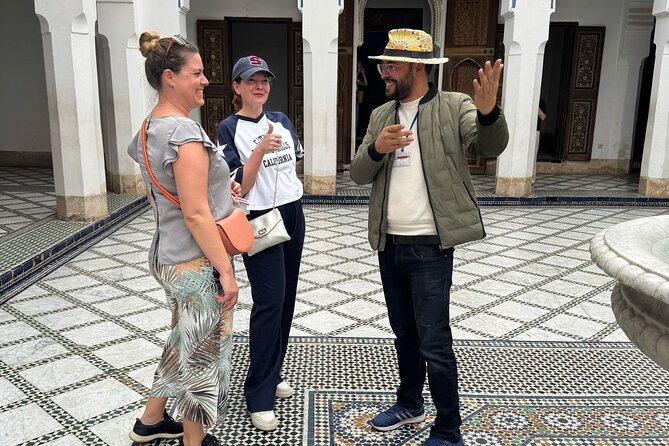
- A certified local guide leads the walk: Mo and Ibrahim are names associated with the guiding, while Mohcine is the listed provider.
- A convenient central start and finish: Meet at Argana, near Jemaa el-Fnaa, at Number 18, Znikat Rahba.
Why this Marrakech medina walk is useful
Marrakech’s old medina is not difficult because it lacks sights. It is difficult because it has too many of them, packed into narrow lanes that can quickly blur together. A guided route gives you a framework: the city’s great monuments first, then the working souks that explain how Marrakech has traded and made things for centuries.
At $23.23 per person, the price is modest for a three-hour walking tour. It does not cover entry to Bahia Palace or Ben Youssef Madrasa, but those fees are relatively small. The real value is the guide’s explanation and the time saved finding your way between the main places.
I would see this as an orientation tour rather than a full cultural course. You get a useful introduction to architecture, religion, education, trade, and daily life. You also get a chance to note places you may want to return to later on your own.
The tour is capped at 20 people. That is not the same as a private walk, and you should expect some waiting when the group gathers in busy lanes or courtyards. Still, the size is limited enough to make questions possible, particularly if the guide keeps the group together well.
More Historical Tours in Marrakech
- Marrakech Historical and Cultural Tour – Half Day City Tour
★ 4.5 · 1,180 reviews - Historical Marrakech Walking Tour
★ 5.0 · 198 reviews - Marrakech: Historical Discovery Tour
★ 4.1 · 87 reviews
Meeting at Jemaa el-Fnaa
The meeting point is at Argana, Number 18, Znikat Rahba, near Jemaa el-Fnaa. This is a practical place to begin because the square is one of the easiest reference points in the medina. The activity also ends back at the same meeting point, which helps if you have plans nearby afterward.
Use the exact address rather than relying only on the name of the square. The medina’s lanes can be confusing, and a central meeting point can still take time to locate. Your booking confirmation arrives at the time of booking, so keep the meeting details available on your phone.
The tour uses a mobile ticket. It is also near public transportation, although the supplied details do not specify which bus or stop to use. Most people can participate, and service animals are allowed.
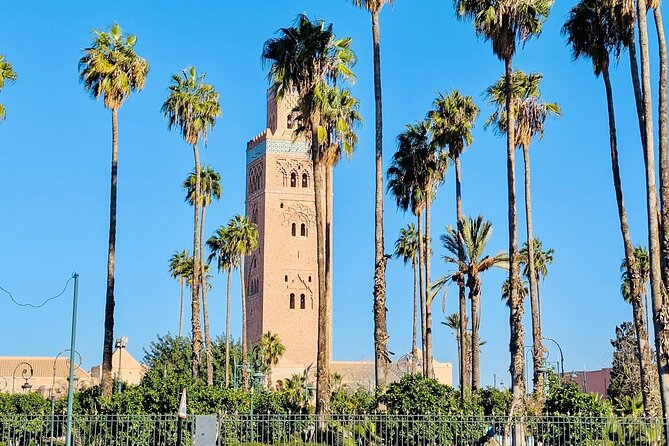
Koutoubia Mosque and the city skyline
Koutoubia is a fitting first sight. Its 12th-century minaret is one of Marrakech’s clearest visual markers, rising above the surrounding city and helping you understand the scale of the old medina.
Your guide explains the minaret’s Andalusian design details, its place in Marrakech’s story, and its importance as a reference point for people approaching the city. This is more useful than simply taking a photograph, since the building helps explain why Marrakech feels organized around a few strong landmarks amid a very dense old quarter.
The surrounding gardens offer a calmer setting and good views of the minaret. The scheduled stop is about 30 minutes, with no admission fee listed. Treat this as an exterior visit and orientation stop, not a promise of access to the mosque’s interior.
I like this opening because it gives you a visual anchor before the route turns into narrow lanes. If you want extensive time for photographs or quiet garden time, you may need to return later. Thirty minutes passes quickly once the guide has explained the building and the group has moved into position for views.
Bahia Palace: tile, wood, and royal life
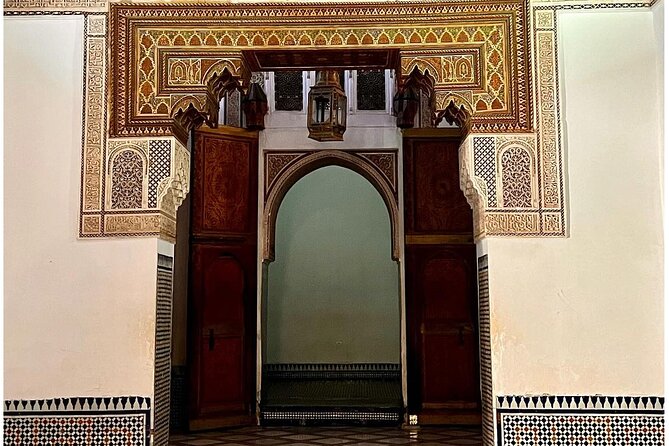
Bahia Palace is the tour’s main architectural stop, with about one hour allocated to it. You enter through a grand doorway and move through gardens, interior courtyards, and decorated rooms.
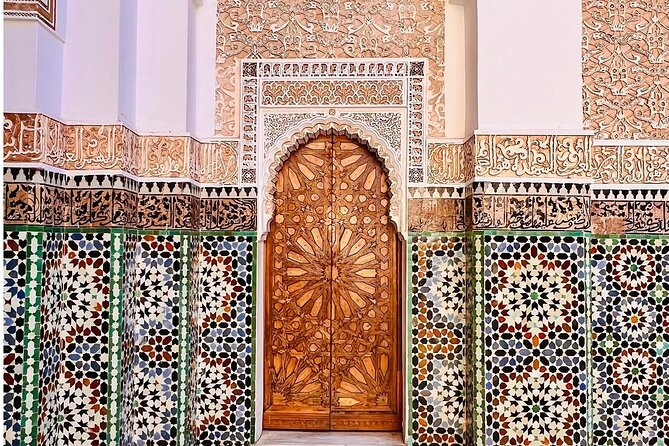
The details matter here. Look for carved wooden ceilings, mosaics, and sculpted decoration. The palace is not simply a large residence to walk through. Its courtyards and rooms show how Moroccan design uses shade, pattern, timber, tile, and enclosed garden spaces to create a sense of privacy and ceremony.
Your guide provides the palace’s political and royal background while pointing out how the structure is arranged. That context is valuable because the rooms can otherwise seem like a series of attractive but disconnected spaces.
Admission is not included and costs less than 10 euros. Bring this amount separately so the group does not lose time while arranging tickets. The exact fee is not given, so check the current price locally.
This is one place where the advertised three-hour length matters. One hour at Bahia Palace leaves less time for the souks and madrasa if the route is moving at a strict pace. If the palace is especially important to you, ask the guide early how much time the group will spend inside and whether the route can be adjusted.
More historic sites out of Marrakech:
- Private Cultural Tour in Marrakech City
★ 5.0 · 77 reviews - 1 Day Guided Tour of World Heritage Kasbah Ait Ben Haddou from Marrakech
★ 3.5 · 73 reviews - Enchanting Half-Day Journey of Marrakech into History & Culture.
★ 4.5 · 72 reviews - private VIP half journey of Marrakesh : History & Culture.
★ 4.5 · 64 reviews
Jemaa el-Fnaa, Marrakech’s public stage
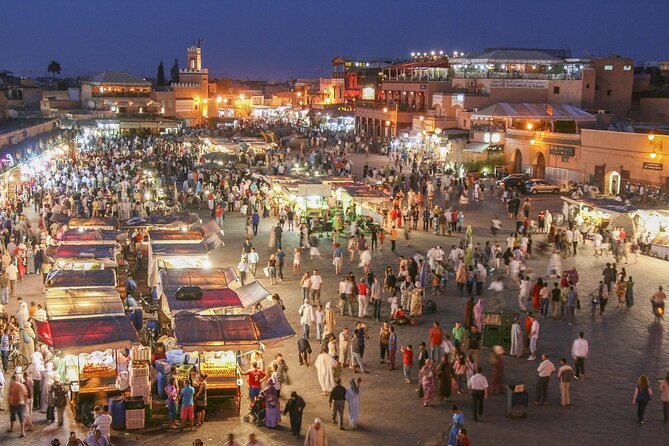
The walk continues to Jemaa el-Fnaa, the great square at the heart of Marrakech. The scheduled visit is about 30 minutes, and there is no admission fee.
Your guide sets the scene by explaining the square’s role in city life and its UNESCO World Heritage status. You may see spice sellers, musicians, street performers, snake charmers, fresh juice stands, restaurants, and colorful shops. The mix changes with the time of day, so the square is not a fixed display. It is a working public place.
This is a good moment to pause and watch rather than rush from one sight to the next. Ask your guide about what is traditional, what is aimed at visitors, and how the square functions for local people. That kind of explanation can help you observe with more care.
Keep your belongings secure in the crowd, and be thoughtful around performers and animals. The tour gives you an introduction, but half an hour is too short to understand every layer of the square. If you enjoy the atmosphere, return independently after the tour and spend more time there.
The souks: shopping with some context
The souks are where the tour becomes less about monuments and more about work, trade, and buying. You follow the guide through twisting lanes lined with goods and workshops, with different sections devoted to spices, fabric, jewelry, leather, metal, wood, and ceramics.
The useful part is not just seeing products. Your guide explains how the markets are organized and how bargaining fits into the local trading tradition. That gives you a better footing if you want to shop later.
You may also find yourself being shown specific shops or workshops. The supplied details mention carpets, lanterns, leather, and spices, but they do not promise a purchase or a demonstration at every stop. Go in with a clear plan. If you are browsing, say so. If you want to buy, ask about materials, origin, care, and the final price before agreeing.
Shopping advice is one of the strongest practical features of this walk. Mo is described as helping with suggestions on where to shop, while Ibrahim is noted for offering useful tips about markets and answering individual questions. The names give you an idea of the guide style to expect: explanation paired with hands-on help.
You should also remember that a shop visit can take time. The more the group stops to inspect goods, the less time remains for the monuments. That is not necessarily bad, but it is worth telling the guide what matters most to you.
The Dyers’ Souk and the work behind the color
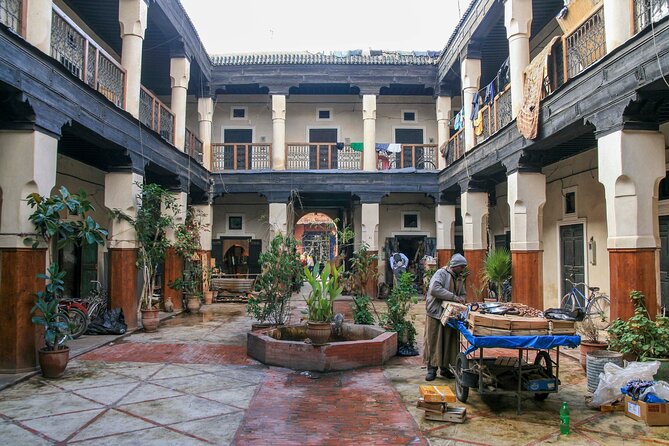
The Dyers’ Souk focuses on cloth and the methods used to color it. You see fabrics in strong shades, natural pigments, dyeing vats, and drying methods.
This stop adds something that the grand palaces cannot. It presents craft as work, not just decoration. The hanging cloth gives you an immediate visual sense of the trade, while the guide explains how these skills have been passed down and why the souk matters to Marrakech’s economy and culture.
The visit may be brief because the overall tour is short. You might find the best value here in asking one or two focused questions: how the colors are produced, how the fabric is dried, and what separates handmade work from factory-made goods. The description does not guarantee that you will see every stage of production, so treat it as an introduction rather than a workshop class.
The carpet souk and the art of bargaining
The carpet souk is aimed at people who want to understand Moroccan rugs or may be considering a purchase. You see Berber and Arabic rugs in different patterns and colors, and the guide explains weaving methods, symbols, and the stories carried by the designs.
You may also watch merchants unroll pieces for inspection. If you want to practice bargaining, this is the place to learn the basic rhythm of the process. Take your time, ask questions, and do not agree to a price simply because the seller has brought out several rugs.
I would not join this tour expecting a neutral professional valuation of a carpet. The guide can explain styles and customs, but the information provided does not promise certification, shipping help, or a guarantee about quality. If you are seriously shopping, treat the tour’s advice as a starting point and inspect the rug carefully before buying.
Even if you do not purchase anything, the stop helps connect design with place. Patterns, weaving methods, and materials become easier to understand when someone explains what you are seeing instead of leaving you to guess.
Ben Youssef Madrasa and student life
Ben Youssef Madrasa is the final major monument and receives about one hour in the planned schedule. It was founded in the 14th century as a Quranic school and welcomed students from across North Africa.
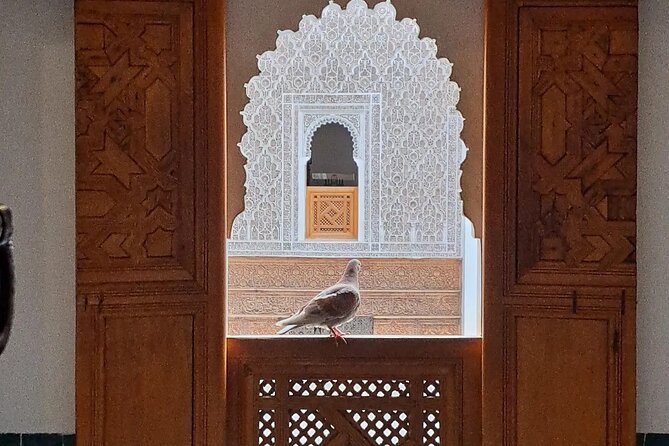
The madrasa’s appeal comes from the contrast between its calm inner spaces and the tight lanes outside. Look for the courtyard, mosaics, curved architectural details, carved wood, and the small student cells. The building shows both the beauty of Moroccan design and the importance of religious education in the city’s past.
The guide’s explanation can help you read the building as a school, not only as a decorated monument. The cells make the institution’s scale more understandable, while the courtyard shows how shared space shaped student life.
Admission is extra and costs less than 5 euros. The fee is small, but you should include it in your budget along with Bahia Palace. The listed one-hour duration is generous compared with the three-hour tour total, especially once the souks are added. Confirm the actual time available if seeing the madrasa in detail is a priority.
Timing, pace, and what you actually cover
The activity is described as lasting about three hours. Koutoubia receives 30 minutes, Bahia Palace one hour, Jemaa el-Fnaa 30 minutes, and Ben Youssef Madrasa one hour. The souks, Dyers’ Souk, and carpet souk are also included in the route, but no separate durations are given for them.
That creates a practical question: the complete list cannot comfortably fit into three hours if every stop receives its full stated time. The guide may combine stops, shorten some visits, or adjust the route according to the group and the day.
This is not a reason to reject the experience. It simply means you should decide what you most want. If you care most about architecture, prioritize Bahia Palace and Ben Youssef Madrasa. If shopping and craft traditions matter more, tell the guide early so the souk time is useful.
The route is on foot through historic lanes. Wear shoes suited to walking and expect a steady pace. The details do not state how much rest time is provided, so ask for a brief pause if needed.
Price, group size, and overall value
At $23.23, this is good value if you want a guide to organize the medina’s main sights and explain what you are seeing. The price includes a certified local guide and professional service, but not the two paid monument entries.
For a realistic budget, add less than 15 euros for both Bahia Palace and Ben Youssef Madrasa, based on the supplied fee ranges. You may also spend money in the souks, but shopping is optional and should not be confused with the tour cost.
The maximum group size is 20. A smaller group would offer more personal attention, but this limit is still more workable than a large coach outing. The strongest value comes when you ask questions, explain your interests, and use the guide’s advice to plan the rest of your time in Marrakech.
Free cancellation is available if you cancel at least 24 hours before the start time. Changes or cancellations inside that window are not accepted for a refund. Confirmation arrives when you book, and the tour ends at the starting point.
Who should book this Marrakech tour?
I would recommend it to a first-time visitor who wants a fast, guided introduction to the medina. It also suits anyone who enjoys asking questions about architecture, local customs, crafts, and shopping rather than simply moving from one photo stop to another.
It is a good fit for people with only part of a day available. The route covers the city’s most important sights in a compact format, and the return to the original meeting point makes it easy to continue exploring afterward.
You may want something else if you prefer long, quiet visits inside museums or palaces. The advertised timing is tight, and the group may need to keep moving. Serious carpet shoppers should also treat the souk portion as guidance, not as a complete buying service.
Should you book it?
Book this tour if you want clear orientation, local cultural context, and practical souk advice for a modest price. The combination of Koutoubia, Bahia Palace, Jemaa el-Fnaa, the craft markets, and Ben Youssef Madrasa gives you a useful picture of Marrakech in one morning or afternoon.
Before booking, decide which parts matter most and be ready to tell the guide. The three-hour schedule is compact, the two major entrance fees are extra, and the group may include up to 20 people. With those limits understood, this is a sensible way to get your bearings and choose where to spend more time on your own.
FAQ
How long does the tour last?
The tour lasts approximately three hours.
What sights are included?
The route includes Koutoubia Mosque, Bahia Palace, Jemaa el-Fnaa, Marrakech’s souks, the Dyers’ Souk, the carpet souk, and Ben Youssef Madrasa.
Are entrance fees included?
No. Entry to Bahia Palace and Ben Youssef Madrasa is not included. Bahia Palace costs less than 10 euros, and Ben Youssef Madrasa costs less than 5 euros.
Where does the tour start?
It starts at Argana, Number 18, Znikat Rahba, near Jemaa el-Fnaa in Marrakech.
Where does the tour finish?
The activity ends back at the meeting point.
What is included in the price?
The price includes a certified local tour guide and professional service. It does not include monument entrance fees.
How many people can join the tour?
The maximum group size is 20 people.
Just listed out of Marrakech
- Marrakech: Ouzoud Waterfalls Trip, Guide & Boat + Lunch★ 4.7 · 33 reviews
- From Marrakech: Ourika Valley Trip, Waterfall Hike & Lunch★ 4.4 · 33 reviews
- Magical Dinner show and Quad bike In Agafay Desert Marrakech★ 4.5 · 33 reviews
- Moroccan Hands on traditional pastries & Tea class in Marrakech★ 4.5 · 33 reviews
- Marrakech: Quad excursion to the palm grove and Jbilets desert★ 4.5 · 33 reviews
- Marrakech: Vibrant Dinner Show at The Lotus Club★ 3.9 · 33 reviews
- From Marrakech: Small Group To Essaouira & Medina Day Trip★ 4.3 · 33 reviews
- From Marrakech: 3-Day Merzouga and Sahara Desert Tour★ 4.5 · 33 reviews
Marrakech Tours, compared.

Agafay Desert Sunset, Camel Ride, and Dinner Show
Read our review →
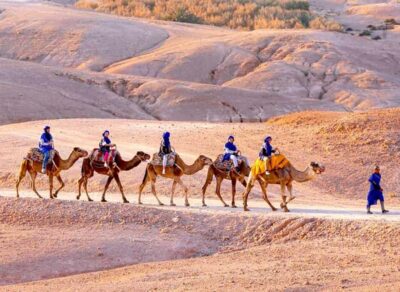
Agafay Desert Quad & Camel Rides with Dinner Show
Read our review →
Agafay Desert Quad Biking Tour with Dinner-Show
Read our review →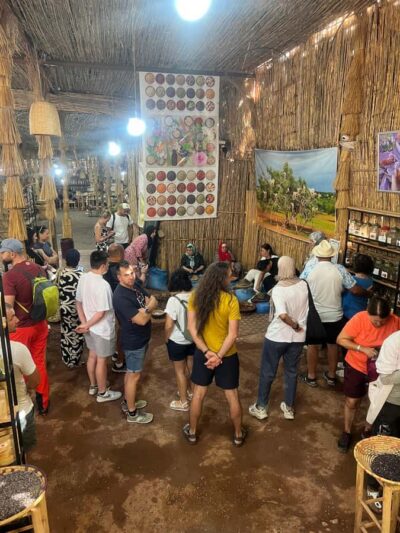
Atlas Mountains, Ourika Valley, Waterfall & Lunch
Read our review →
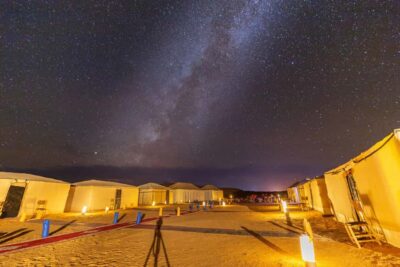

Quad Bike Tour to Palm Oasis and Jbilat Desert
Read our review →Browse the lists this tour appears in