
Reviewed · MARRAKECH TOURS
3 Days Morocco Desert Marzouga Tour from Marrakech To Fès
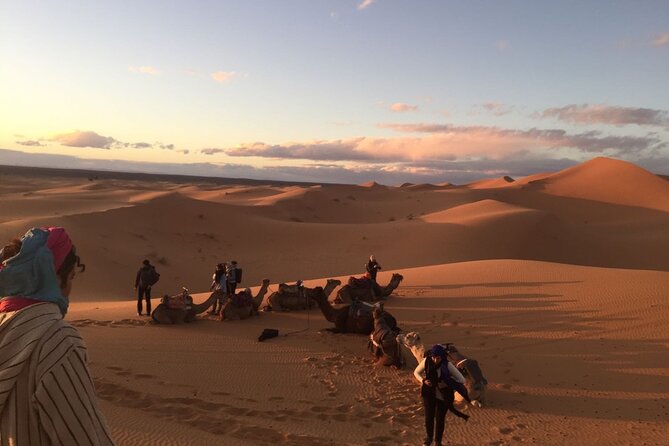
The best part of this trip is the change in scenery. You leave Marrakech behind, cross the High Atlas, pass mud-brick villages and old kasbahs, then reach the orange dunes of Erg Chebbi for a sunset camel ride and a night beneath the stars. The next evening, you arrive in Fès, Morocco’s cultural capital.
I like the way the main transport, two breakfasts, two dinners, desert lodging, and the camel ride are arranged in one booking. I also like the human touch along the route. Abdul, the guide on the first day, is described as kind, engaging, and informative, while the local Moroccan and Berber guides bring real warmth to the stops.
The trade-off is the distance. This is a fast three-day crossing with long hours in a shared vehicle, not a slow desert holiday. Lunches, a guide, sandboarding, and ATV rides cost extra, and the desert arrangements may feel less polished than the scenery deserves.
Key points to know before booking
- The route crosses Morocco from Marrakech to Fès: You see the High Atlas, Ait-Ben-Haddou, the Roses Valley, Dades Gorge, Todra Gorge, Merzouga, Ifrane, and the Fès medina.
- The desert night is the main event: Ride a camel at sunset, eat Sahrawi tagine, listen to Berber songs, and sleep in a local tent under the stars.
- Expect a maximum group of 17: A group this size keeps the price low but can make stops and hotel arrangements less flexible.
- Two breakfasts and two dinners are included: You still need to budget for both lunches and optional dune activities.
- The vehicle handles the difficult logistics: Your professional driver manages the long route, with breaks built in for fresh air and rest.
- Abdul is a useful name to request if available: He received particular praise for his manner and information on the first part of the journey.
Crossing the High Atlas on the first morning
The first day begins with a serious road journey. Your vehicle climbs through the High Atlas toward Tizi n’Tichka, the highest pass in North Africa, where the scenery changes from the greener surroundings of northern Morocco to dry, open country on the southern side.
This is one of the strongest parts of the route because the road itself becomes part of the experience. You pass Berber villages, watch the colors and vegetation shift, and see homes built from mud. The frequent breaks are useful, not wasted time. The desert is a long way from Marrakech, and the operator says drivers must stop to rest and give everyone a chance to get fresh air.
If Abdul is leading the first section, you can expect a guide who adds context rather than simply pointing out the view. His style has been described as informative, engaging, kind, and courteous. That matters on a road-heavy day, when a good guide can turn passing scenery into a clearer picture of village life and old caravan routes.
The route is not designed for a lie-in. You spend much of the day on the road, so bring water, snacks, sun protection, and something small enough to keep beside you. The shared vehicle is air-conditioned, but three days of changing temperatures and long drives make light layers a sensible choice.
A few other Marrakech days worth comparing
- From Marrakech: 3-Day Merzouga and Sahara Desert Tour
★ 4.9 · 15,308 reviews - From Marrakech: Merzouga 3-Day Desert Safari with Food
★ 4.7 · 12,232 reviews - 3 Days Desert Tour From Marrakech To Merzouga Dunes & Camel Trek
★ 5.0 · 10,125 reviews
Ait-Ben-Haddou and the old caravan roads
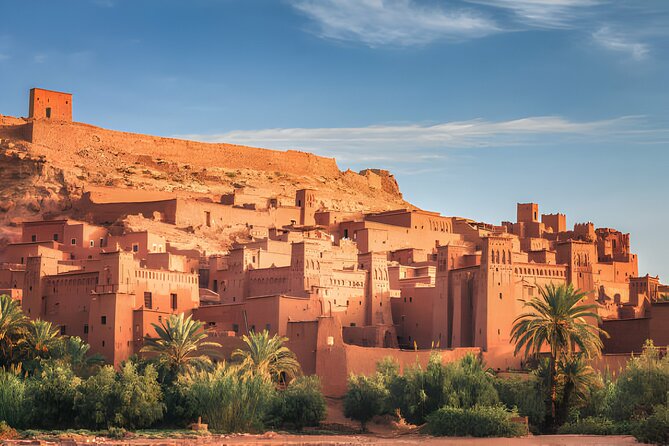
Ait-Ben-Haddou gives the first day a strong historical and visual anchor. This fortified village, built from earth-colored materials, is a UNESCO World Heritage Site and has appeared in Hollywood films. It is the kind of place that looks striking from a distance, then rewards a closer look at its lanes, walls, and old trading role.
The wider route also includes Telouet Kasbah, once linked to the Pasha of the Atlas, the Glaoui. Much of the kasbah was left in ruin after the French armies departed, but tiled walls and fluted pillars still hint at its former status. The contrast is worthwhile: Ait-Ben-Haddou feels like a preserved stronghold, while Telouet offers a more weathered, damaged sense of the past.
The scheduled time around this section is about two hours, with admission listed as free. That does not mean the stop is slight. You get a compact look at mud construction, old trade routes, local art, and mountain villages before the road turns toward the valleys.
The main limitation is pace. You are seeing several major places in a single day, so you should not expect a long, quiet study of either kasbah. If you want detailed architectural interpretation, note that a guide is not included in the listed price. Your driver and local guides may provide information, but the arrangements are not the same as hiring a dedicated historian for the whole route.
The Roses Valley and a night near Dades Gorge
The drive continues through the Roses Valley and toward Dades Gorge. The valley is part of the gradual transition from mountain country to the dry southeast, and the changing colors make the journey feel less repetitive than the mileage suggests.
Dades is where you spend the first night. The gorge was cut by the Dades River, which begins in the High Atlas and runs for roughly 350 kilometers before meeting the Draa River near the Sahara. The cliffs and valley give you a welcome change from the vehicle after the long crossing.
The itinerary assigns about 13 hours to this first day, including the route and overnight stop. That figure tells you what kind of trip this is: efficient and full, but tiring. I would choose it if you have limited time and want to reach Fès after seeing the desert. I would not choose it if you dislike early starts, winding roads, or long periods sitting in a vehicle.
Dinner is included, which simplifies the evening. Breakfast and dinner are provided on both nights, but lunch is not. Keep cash available for meals and drinks along the route, since the package does not cover midday food.
Todra Gorge before the Sahara
Day two begins with Todra Gorge, near Tinerhir. The Todgha and Dades Rivers carved these limestone canyons through the eastern High Atlas, with some walls rising as high as 400 meters. The gorge is more dramatic in scale than the first day’s valleys, and the two-hour stop gives you time to walk, take photographs, and stretch your legs.
This is a good example of why the route works despite the long drives. You are not simply being delivered from one city to another. The major road sections are broken up by places with a clear sense of geology, local life, and regional character.
Still, keep your expectations practical. The included service does not list a private guide at Todra Gorge, and the stop is limited. You can take in the cliffs and atmosphere, but a specialist geology talk or a long hike is not part of the plan.
From Todra, the road continues toward Merzouga. The desert arrival is likely to feel especially welcome because it follows another substantial drive. This is when the trip shifts from road sightseeing to the experience most people book it for.
Same city, a completely different day out:
- Marrakech: Agafay Desert Sunset, Camel Ride, and Dinner Show
★ 4.6 · 35,119 reviews - From Marrakech: Ouzoud Waterfalls Guided Hike and Boat Trip
★ 4.7 · 33,630 reviews - Marrakech: Agafay Desert Quad & Camel Rides with Dinner Show
★ 4.8 · 27,382 reviews - Marrakech: Agafay Desert Quad Biking Tour with Dinner-Show
★ 4.8 · 16,569 reviews
Sunset by camel in the Erg Chebbi dunes
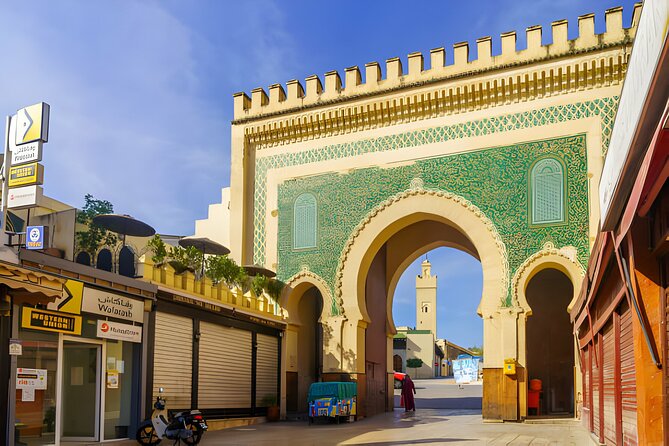
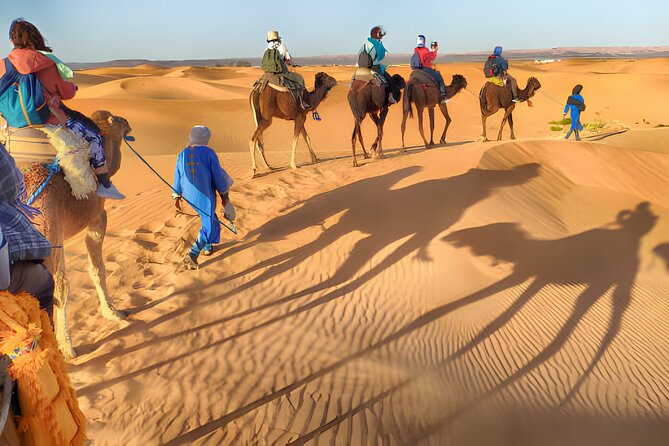
At Merzouga, you ride camels into the Erg Chebbi dunes around sunset. The camel portion is listed at about an hour, enough for the classic approach to the sand and for photographs as the light changes.
Bring your camera, but also keep the photo stop in perspective. The desert offers broad lines, warm colors, and strong reflections when conditions are right, yet the most useful approach is to enjoy the ride rather than treat it only as a photo session. Secure loose items and protect your phone from sand.
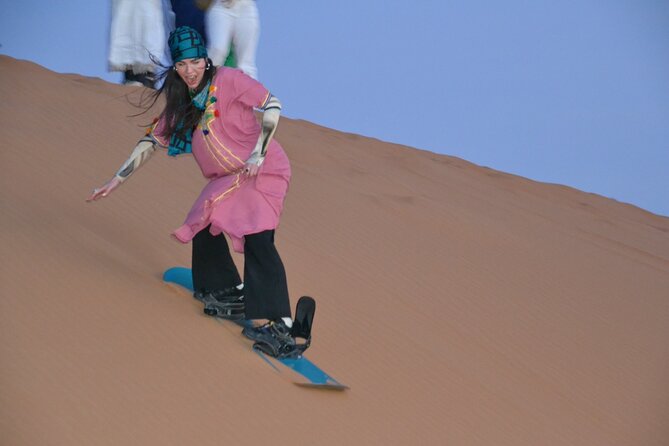
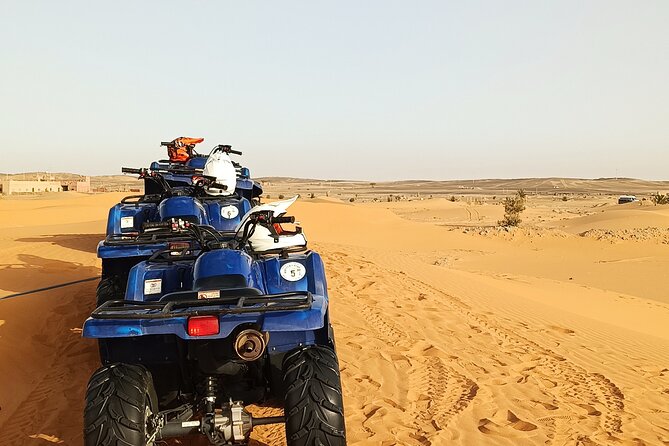
Sandboarding and ATV riding are available at additional cost. These options suit you if you want more action after the camel ride, but they are not included in the $132.76 starting price. If you are watching your budget, the camel ride and desert evening already provide the main experience.
The camel guide is an important part of this moment. The trip includes local guides, and the camel guide has been praised for being helpful and for taking good photographs. No specific name is supplied, so you cannot request that person by name in advance, but you can expect the desert portion to have its own local support rather than relying only on the vehicle driver.
A Berber tent, Sahrawi tagine, and a night under the stars
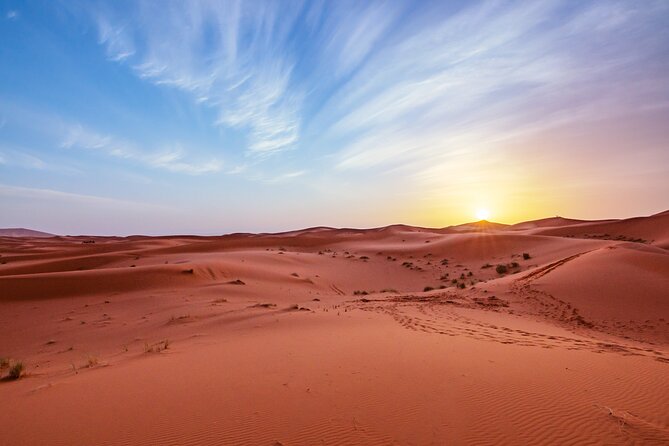
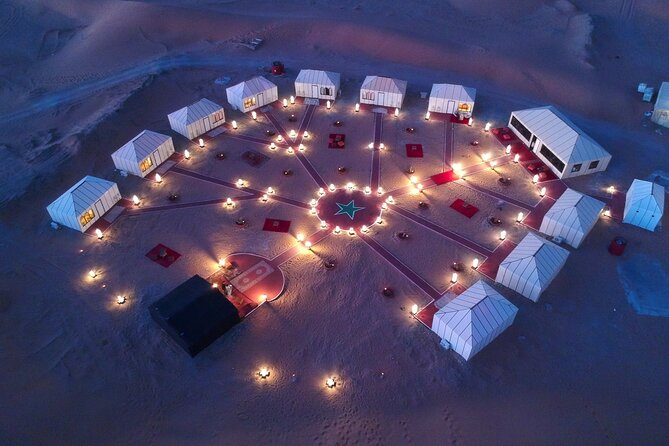
The overnight camp is the emotional high point of the journey. You spend the night in a local tent, eat a Sahrawi tagine, and gather around a fire for Berber songs and dancing. Dinner is included, so this is more than a transfer with a bed at the other end. It gives you an evening tied to the desert setting.
The camp experience is also where you should pack thoughtfully. One piece of direct advice is to bring your own towel and keep your luggage small. A smaller bag is easier to handle during the camel transfer and more practical around a basic desert camp.
Do not assume hotel-style service. The arrangements may be simple, and the overnight setup can feel disorganized at times. That is not necessarily a flaw if you approach it as a local tent experience, but it matters if you want polished facilities, private comforts, or carefully managed celebrations. A birthday request, for example, did not result in the special arrangement promised, so personal events may be better suited to a private tour.
The night lasts about 16 hours in the schedule, including the evening, sleep, sunrise, and morning meal. This is not a late-night party followed by a leisurely breakfast. You will need to rise early for the dunes.
Sunrise, the road to Ifrane, and arrival in Fès
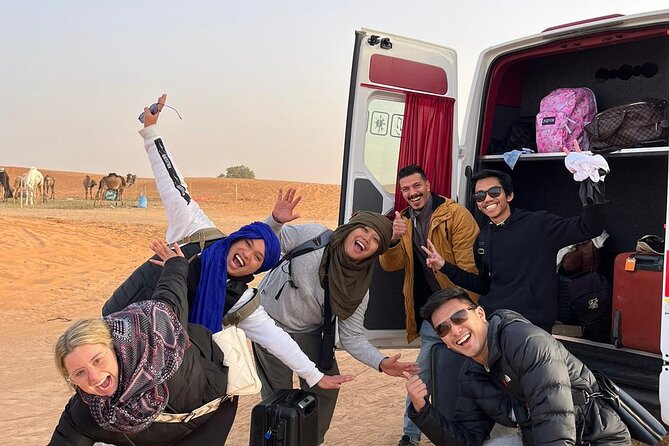
On the third morning, you watch the sunrise, ride the camel back to the camp lodge, and have breakfast. Sunrise is one of the best reasons to accept the early start. The dunes look different in the low light, and the return ride completes the desert portion without requiring another separate transfer.
The day then becomes another long road journey. Ifrane National Park is a brief stop, listed at about 15 minutes, where you can take photographs with monkeys. Ifrane itself is often called the Switzerland of Morocco, a nickname reflecting its different architectural and climatic character. Here, the stop is short and focused on the monkeys and a quick break, not a full visit to the town.
You reach Fès in the early evening. Drop-off is available at your accommodation or at the nearest accessible point, then the service ends in the Fès medina area. Because the route covers so much ground, do not schedule an important evening activity immediately after arrival. Delays can happen on a road trip of this length, and you will probably want a quiet meal and rest anyway.
The ending works well for visitors building a one-way Morocco route. Instead of returning to Marrakech, you finish in Fès, which saves you from retracing the same desert road. That one-way design is a major part of the tour’s value.
What the $132.76 price really covers
At $132.76 per person, this is a low-cost way to link Marrakech, the Sahara, and Fès. Your price covers an air-conditioned vehicle, a professional driver, two breakfasts, two dinners, the arranged overnight stays, and the camel experience. It also covers the planning burden of connecting remote places that are difficult to combine independently in only three days.
The price does not cover lunch, a dedicated guide, sandboarding, or ATV riding. Those extras can change the final cost, so make a small budget for food and optional activities. The tour has a maximum of 17 people, which helps explain the low price but also means you are buying a shared group schedule rather than a private journey.
I see the strongest value in the route, not in comfort. You get a great number of major sights for the money, especially if your larger Morocco trip already includes time in Marrakech and Fès. You give up flexibility, quiet, and some control over how long you stay at each stop.
The experience is booked, on average, 48 days ahead, which suggests that planning early is sensible. Confirmation is provided at booking, pickup is offered, and mobile tickets are accepted. Free cancellation is available up to 24 hours before the start time. Changes or cancellations inside that 24-hour window are not accepted for a refund.
Who should book this Marrakech to Fès desert crossing
I would recommend this trip to you if you have only a few days and want the largest possible taste of southern Morocco. It suits first-time visitors who value a planned route, do not want to arrange several hotels and transfers, and are happy to share the vehicle with a group.
It is also a good fit if your larger itinerary runs from Marrakech toward Fès. The one-way finish saves time, while the included dinners and breakfasts reduce the number of details you need to organize.
I would think twice if you need long walks, private rooms, a dedicated guide, or reliable celebration planning. The long road days are real, the desert camp may be basic, and a group of up to 17 can make the schedule feel less personal. You should also be comfortable with camel riding and early mornings.
Should you book the Merzouga tour?
Book it if your priority is seeing a lot of Morocco in three days, especially the camel ride, desert camp, kasbahs, and mountain gorges. The combination of scenery and one-way transport gives this trip solid value at $132.76.
Skip it in favor of a longer or private option if comfort and flexibility matter more than coverage. Pack a small bag, bring your own towel, carry money for lunch and optional dune activities, and treat the long drives as part of the bargain. With those expectations, this is an efficient and memorable way to cross Morocco from Marrakech to Fès.
FAQ
How long is the Morocco desert tour?
The experience lasts approximately three days, beginning in Marrakech and ending in Fès in the early evening of the third day.
What cities does the tour connect?
The route starts in Marrakech and finishes in Fès. Drop-off is provided at your accommodation or the nearest accessible point.
Is pickup offered?
Yes. Pickup is offered, and the booking includes a mobile ticket.
How many people can join the group?
The group can include a maximum of 17 travelers.
What meals are included?
Two breakfasts and two dinners are included. Lunch is not included.
Is the camel ride included?
Yes. The camel ride in the Merzouga desert is included, with a sunset ride and a return ride after sunrise.
Are sandboarding and ATV riding included?
No. Sandboarding and ATV riding are optional activities that require an additional payment.
Can I cancel for a full refund?
Yes. You can cancel at least 24 hours before the experience start time for a full refund. Cancellations or changes made less than 24 hours in advance are not accepted for a refund.
Just listed out of Marrakech
- Marrakech: Ouzoud Waterfalls Trip, Guide & Boat + Lunch★ 4.7 · 33 reviews
- From Marrakech: Ourika Valley Trip, Waterfall Hike & Lunch★ 4.4 · 33 reviews
- Magical Dinner show and Quad bike In Agafay Desert Marrakech★ 4.5 · 33 reviews
- Marrakech: Quad excursion to the palm grove and Jbilets desert★ 4.5 · 33 reviews
- Moroccan Hands on traditional pastries & Tea class in Marrakech★ 4.5 · 33 reviews
- Marrakech: Vibrant Dinner Show at The Lotus Club★ 3.9 · 33 reviews
- From Marrakech: Small Group To Essaouira & Medina Day Trip★ 4.3 · 33 reviews
- From Marrakech: 3-Day Merzouga and Sahara Desert Tour★ 4.5 · 33 reviews
Marrakech Tours, compared.

Agafay Desert Sunset, Camel Ride, and Dinner Show
Read our review →

Agafay Desert Quad & Camel Rides with Dinner Show
Read our review →
Agafay Desert Quad Biking Tour with Dinner-Show
Read our review →
Atlas Mountains, Ourika Valley, Waterfall & Lunch
Read our review →


Quad Bike Tour to Palm Oasis and Jbilat Desert
Read our review →Browse the lists this tour appears in