
Reviewed · MARRAKECH TOURS
Marrakech through the eyes of a Local
Marrakech is easiest to understand on foot, one turning at a time. This half-day tour leads you from the grand Koutoubia Mosque into the medina’s tight lanes, then through palaces, markets, the old Jewish quarter, and Jemaa el-Fnaa. Mohamed, the named guide most often associated with this experience, brings a personal feel to the route and can adjust it to your interests.
I like two things right away: the mix of major sights and ordinary city life, and the useful three-to-four-hour length. You see important monuments without signing away an entire day, and you get time in the souks rather than being hurried from one ticket booth to another.
The main consideration is cost at $45 per person, since historic monument entrance fees are extra. The route also involves narrow streets and plenty of walking, so it suits you best if you have moderate fitness and are comfortable with the sensory rush of the old city.
Key details that shape the experience
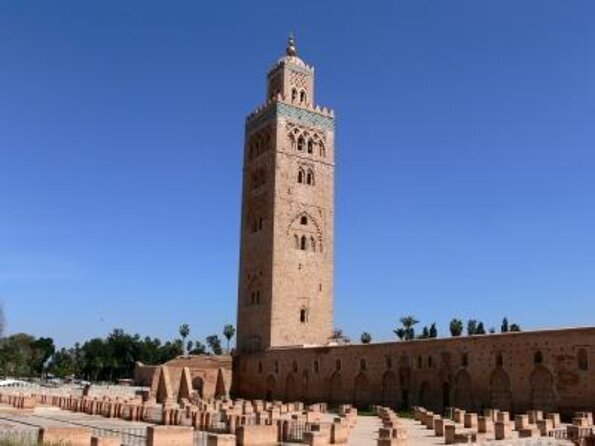
- Koutoubia’s 77-meter minaret: Begin with Marrakech’s best-known landmark and an easy introduction to the city’s Islamic architecture.
- A walk through the Mellah: See the former Jewish quarter, its market, spice souk, synagogue, and cemetery area.
- Bahia Palace visit: Allow extra money for admission and expect about 45 minutes inside this nineteenth-century palace and garden complex.
- Souks beyond the main square: The route includes Rahba Kdima, olive markets, and other old-city lanes where local trade matters as much as sightseeing.
- A guide who adapts the day: Mohamed has been praised for patience, humor, clear explanations, and adjusting plans around family interests.
- Mint tea included: A small but welcome pause is part of the guiding service.
Starting at Koutoubia Mosque
The tour begins at 10:00 a.m. near the Musée du Patrimoine Immatériel beside Jemaa el-Fnaa. That meeting point puts you right at the edge of Marrakech’s old city, where modern streets give way to the medina.
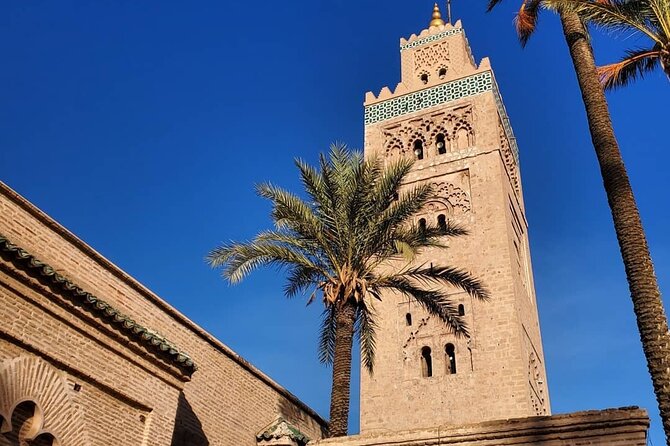
Koutoubia Mosque is a strong first stop because it gives you a fixed point in a city that can otherwise feel like a maze. Its 77-meter minaret rises above Marrakech, decorated with curved windows, pointed merlons, arches, and a ceramic band. Gardens surround the mosque, and the building is lit at night, though this morning tour focuses on the exterior setting and its place in the city.
Admission here is free. You should also know that this is a working mosque, not a standard sightseeing interior. The value comes from understanding the architecture, the minaret’s importance as a city marker, and the way the mosque anchors the medina.
I like beginning here because you can still look around with a clear head. Later, the lanes become tighter and the market activity more intense. Your guide can use Koutoubia to explain the layout of Marrakech before you start making turns through the old city.
A few other Marrakech days worth comparing
- Marrakech: Agafay Desert Sunset, Camel Ride, and Dinner Show
★ 4.6 · 35,119 reviews - From Marrakech: Ouzoud Waterfalls Guided Hike and Boat Trip
★ 4.7 · 33,630 reviews - Marrakech: Agafay Desert Quad & Camel Rides with Dinner Show
★ 4.8 · 27,382 reviews
Riad Zitoune El Kdime and the southern medina
From Koutoubia, the route moves toward Riad Zitoune El Kdime, an old-city area south of the main square. The name refers to an older neighborhood of Marrakech, and the walk helps shift your attention from isolated monuments to the shape of the medina itself.
This is where a local guide matters. On your own, you may see a stream of doors, walls, shops, and alleys without knowing what connects them. Mohamed’s role is to give the streets a human scale, explaining how the areas fit together and pointing out details that are easy to pass.
The route is not a simple march between famous buildings. It is designed to show daily movement through the medina, with its narrow lanes, trades, markets, and social spaces. You should expect a walking experience rather than a vehicle-based city tour.
Because the full path can vary, the pace may depend on your group. Families, first-time visitors, and people keen on food, architecture, shopping, or local culture can ask for adjustments. The provider says the tour can be personalized, which is useful if you have already seen one of the monuments or want more time in the markets.
Bahia Palace and the price of seeing it properly
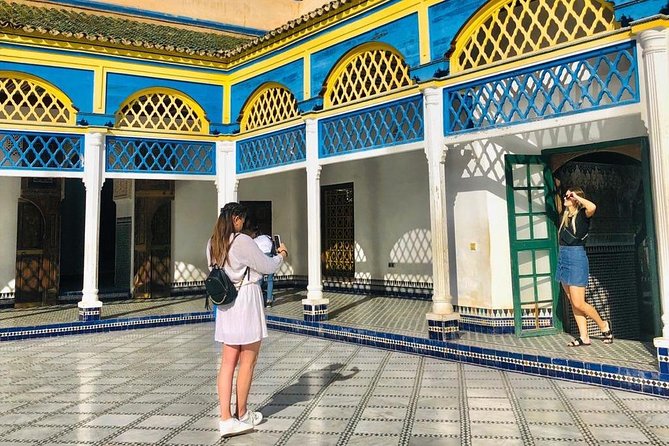
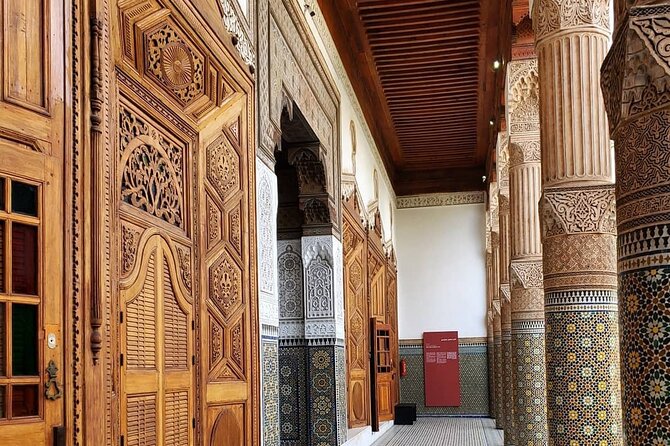
Bahia Palace gets about 45 minutes, making it the longest scheduled monument stop. Built at the end of the nineteenth century, it was intended to be the largest palace of its time. Its courtyards, rooms, decorative surfaces, and gardens offer a calmer contrast to the streets outside.
Entrance is not included in the $45 tour price. This is the most important cost detail to keep in mind. Your fee pays for the guide and the walking experience, but you should budget separately for monument tickets.
I consider the extra fee reasonable if you want context rather than a quick look. Palace buildings can blur together when you visit several in one morning. A guide can explain what you are seeing and help you notice how the rooms and open spaces work as a royal complex.
Still, 45 minutes is not an unlimited visit. If you are a serious architecture enthusiast or a photographer who likes to linger, you may want to confirm how much flexibility the group has. The overall tour includes many stops, so the schedule favors a broad introduction rather than one long palace study.
The Mellah, where Marrakech’s history becomes local and specific
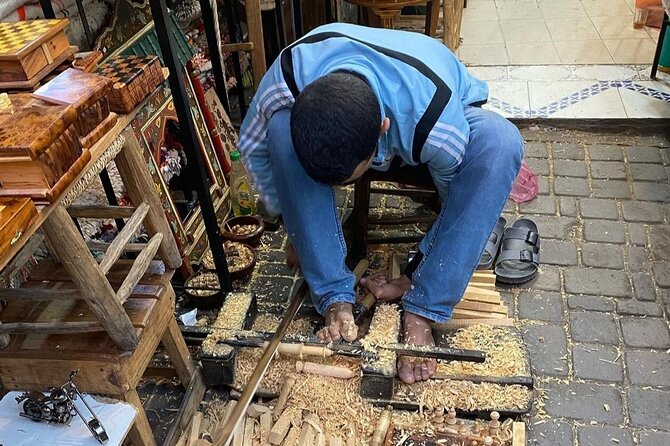
The Mellah was once home to Marrakech’s Jewish population. This part of the route gives the tour a wider view of the city, beyond the familiar image of mosques, riads, rugs, and market stalls.
The narrow streets once formed a distinct quarter. Nearby points of interest include the Lazama Synagogue, with a tiled courtyard and displays connected to Jewish life, and the Miaara Jewish cemetery. The area also includes the Mellah Market, where meat and produce are sold, along with the Bab Mellah spice souk.
You may also find European-style cafés, Moroccan restaurants, and stalls serving steak and tajine. The mix gives you a practical sense of how the neighborhood functions today, rather than treating it only as a historic exhibit.
This stop is especially useful if you want to understand that Marrakech has never been culturally one-note. The Mellah adds another layer to the city’s story, and a guide can help you connect the buildings, market activity, and religious sites.
The trade-off is that not every part of the Mellah is guaranteed to receive the same amount of time. The experience lasts only three to four hours and includes several districts. If the quarter is your main interest, tell Mohamed early and ask whether the route can give it more attention.
Same city, a completely different day out:
- Marrakech: Agafay Desert Quad Biking Tour with Dinner-Show
★ 4.8 · 16,569 reviews - Marrakech: Atlas Mountains, Ourika Valley, Waterfall & Lunch
★ 4.8 · 15,834 reviews - From Marrakech: 3-Day Merzouga and Sahara Desert Tour
★ 4.9 · 15,308 reviews - Berber villages : Atlas Mountains Day Hike from Marrakech
★ 5.0 · 14,007 reviews
Souks, olive markets, and Rahba Kdima
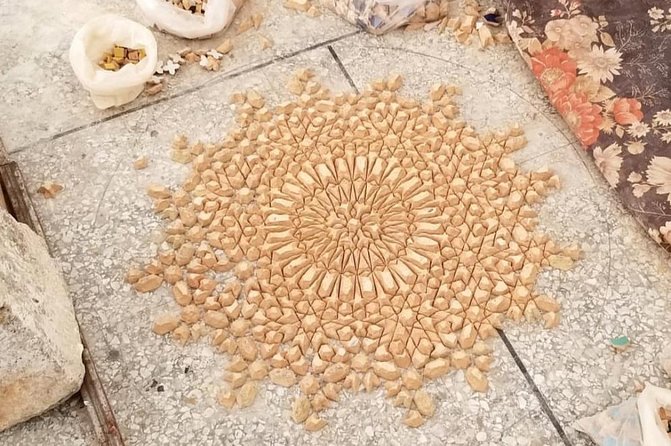
The souks are where the tour’s title makes the most sense. You are not simply walking through a shopping arcade. You are moving through a working part of the medina, with narrow lanes, changing smells, local commerce, and the constant need to keep an eye on the route.
The tour includes the olive markets and Rahba Kdima, also known as the old spice square. These areas help you see how Marrakech’s market culture is organized. You can expect a route that gives you the feel of the souks and points out local industry, rather than only stopping at the most polished stalls.
I like this part because a guide can make shopping less awkward. You can ask questions about what you are seeing, learn how different areas of the souk relate to one another, and get your bearings before exploring alone later.
The experience is not presented as a dedicated shopping tour, so you should not expect a long bargaining session or a guaranteed purchase stop. That is a strength if you want to avoid spending half a day in shops. It can be a limitation if buying crafts is your main goal.
Keep your group together in the narrow lanes. The tour allows up to 17 people, a manageable maximum but still large enough that the group may stretch out in a busy market. Comfortable shoes and a moderate level of fitness will make this section much easier.
Jemaa el-Fnaa, Marrakech’s great meeting place
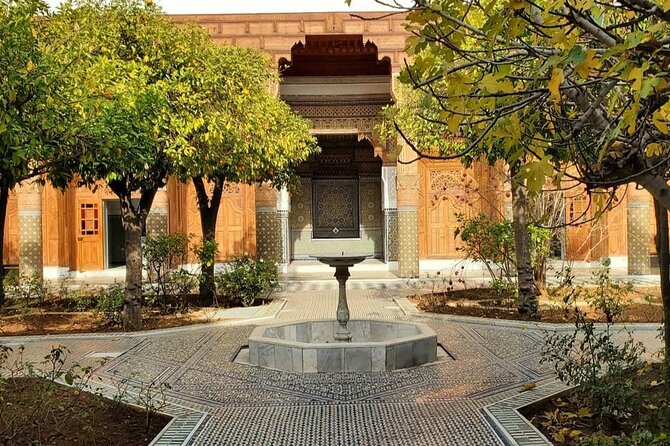
Jemaa el-Fnaa is both a square and a market, and it remains the main public meeting place in Marrakech. Since the tour starts nearby and returns to the meeting point, the square frames the experience as both beginning and ending point.
The scheduled stop lasts about 30 minutes. That gives you time to understand the square without pretending you can absorb all of it in one visit. The place changes with the hour, and a morning visit has a different feel from the evening scene.
Your guide can help you read the square as part of local life, not just as a photo stop. It is a place used by local people and tourists, and its value comes from seeing how the city gathers, trades, eats, and moves through a shared public space.
You may want to return independently later, but remember that this tour ends back at the original meeting point. The morning schedule is useful because you can continue your own exploration afterward.
Rahba Kdima and Ben Youssef
The route also lists Rahba Kdima and Ben Youssef among its sights. Ben Youssef is one of the key names in the medina, but the Quranic School is closed for restoration. That means you should not book this tour expecting to enter that school.
The stop can still help you understand the area and its place in Marrakech’s religious and educational past, but the closure changes what you will see. Ask the guide how the current route handles Ben Youssef on the day of your visit, especially if the site is a top priority.
This is a good example of why a guided walk can be more useful than a rigid checklist. Restoration work can remove a major interior from the schedule, while the surrounding district remains worth seeing. A local guide can explain the change and use the available time elsewhere.
The tour’s mention of Rahba Kdima also reinforces its market focus. You are getting a broad slice of the medina, from major architecture to places where goods are bought and sold. That balance is more useful for a first visit than a monument-only route.
What the guide adds
The strongest pattern in the available feedback is the guide’s personal service. Mohamed is repeatedly described as prompt, friendly, patient, funny, and easy to understand. He has guided couples, families, and small private groups, and he is praised for keeping children interested while answering their questions.
That matters in Marrakech. A good guide needs more than dates and names. You need someone who can pace a walk, explain a confusing street, answer questions without rushing, and notice when your group needs a pause.
Mohamed has also been praised for adapting the route to individual interests. One family chose to adjust its plan when a child had had enough architecture, while other groups asked for a broad introduction to the city. The provider says the experience can be personalized fully, so you should state your priorities before starting.
English and Spanish have been used during the experience. If language is important for your group, confirm your needs when booking rather than relying on assumptions.
One unusual detail gives you a sense of the guide’s approach to service. After one tour, a guest’s mother-in-law was hit by a motorized scooter, and Mohamed helped the family coordinate assistance and reach an international clinic. That incident was outside the sightseeing itself, but it points to a guide who takes responsibility for people in his care.
Is $45 a fair price?
At $45 per person, this is not the cheapest way to wander through Marrakech. You can walk through parts of the medina without paying for a guide, and several listed sights, including Koutoubia and Jemaa el-Fnaa, have no admission charge.
The value comes from the organization and interpretation. You get three to four hours with a professional guide, a planned route through several districts, mint tea, and help making sense of places that can feel confusing on your first day. Entrance fees are extra, so compare the total cost with your priorities.
For me, the price makes the most sense when you book this early in your stay. A first-day or second-day walk can give you a city map in your head, making later independent visits easier. It is less compelling if you already know the medina well or mainly want a single palace visit.
The tour is booked an average of 14 days ahead, so you should not leave it until the last minute if Mohamed’s availability or a particular date matters to you.
Timing, group size, and comfort
The tour starts at 10:00 a.m. and runs for approximately three to four hours. That leaves the rest of your day free for lunch, shopping, a garden visit, or another part of Marrakech.
The maximum group size is 17 people. That is small enough for a shared walking tour, though not the same as a private visit. If you want frequent questions, a slower pace, or a route built around one interest, ask about personalization before you book.
You need moderate physical fitness. The streets are narrow, the route is on foot, and the market sections can be demanding if you are not used to extended walking. Wear practical shoes and carry water, even though mint tea is included.
The meeting point is Musée du Patrimoine Immatériel Jaama El Fna, at J2G6+385 Jamaâ El-Fna, Marrakech 40000, Morocco. The activity ends back there. Confirmation arrives at booking, and mobile tickets are accepted.
Free cancellation is available up to 24 hours before the start time. Changes or cancellations made later are not refunded, and poor weather or failure to meet the minimum group size can lead to a different date or a full refund.
Who should book this Marrakech walking tour?
I would recommend it most strongly for a first visit, especially if you want the city explained rather than simply photographed. It suits couples, families, and small groups who want a guide with a relaxed manner and enough flexibility to answer questions.
It is also a good fit if you want both famous sights and less polished parts of the medina. Koutoubia, Bahia Palace, Jemaa el-Fnaa, the Mellah, olive markets, Rahba Kdima, and Ben Youssef create a broad introduction.
You may want another option if you dislike walking, need a fully private pace, or want long visits inside each monument. The Quranic School at Ben Youssef is closed for restoration, and entrance fees are not part of the price.
Should you book it?
Book this tour if you want a practical first look at Marrakech with a guide who can explain the city, adjust the route, and help you feel more at ease in the medina. The best value comes from using it early in your stay, then returning to the souks and Jemaa el-Fnaa on your own.
Skip it if you already have a strong plan for the old city or care mainly about visiting interiors at length. For most first-time visitors, though, the combination of Koutoubia, Bahia Palace, the Mellah, markets, and a personable guide makes this a useful half-day introduction.
FAQ
How long does the Marrakech through the eyes of a Local tour last?
The experience lasts approximately three to four hours.
What time does the tour begin?
The stated start time is 10:00 a.m.
Where does the tour meet?
It starts at Musée du Patrimoine Immatériel Jaama El Fna, near Jemaa el-Fnaa, at J2G6+385 Jamaâ El-Fna, Marrakech 40000, Morocco.
Where does the tour end?
The activity ends back at the meeting point.
What sights are included?
The route includes Koutoubia Mosque, Riad Zitoune El Kdime, the Mellah, Bahia Palace, Jemaa el-Fnaa, the olive markets, Rahba Kdima, and Ben Youssef.
Is the Quranic School at Ben Youssef open during the tour?
No. The Quranic School is closed for restoration.
Are monument entrance fees included?
No. Entrance fees to historic monuments are not included in the tour price.
Is food or drink included?
Guiding services and coffee or mint tea are included. No meal is listed as part of the experience.
How many people can join the tour?
The maximum group size is 17 people.
Can I cancel for a full refund?
Yes, if you cancel at least 24 hours before the experience start time. Cancellations or changes made less than 24 hours before the start are not refunded.
Just listed out of Marrakech
- Marrakech: Ouzoud Waterfalls Trip, Guide & Boat + Lunch★ 4.7 · 33 reviews
- From Marrakech: Ourika Valley Trip, Waterfall Hike & Lunch★ 4.4 · 33 reviews
- Magical Dinner show and Quad bike In Agafay Desert Marrakech★ 4.5 · 33 reviews
- Moroccan Hands on traditional pastries & Tea class in Marrakech★ 4.5 · 33 reviews
- Marrakech: Quad excursion to the palm grove and Jbilets desert★ 4.5 · 33 reviews
- Marrakech: Vibrant Dinner Show at The Lotus Club★ 3.9 · 33 reviews
- From Marrakech: Small Group To Essaouira & Medina Day Trip★ 4.3 · 33 reviews
- From Marrakech: 3-Day Merzouga and Sahara Desert Tour★ 4.5 · 33 reviews
Marrakech Tours, compared.

Agafay Desert Sunset, Camel Ride, and Dinner Show
Read our review →

Agafay Desert Quad & Camel Rides with Dinner Show
Read our review →
Agafay Desert Quad Biking Tour with Dinner-Show
Read our review →
Atlas Mountains, Ourika Valley, Waterfall & Lunch
Read our review →

