
Reviewed · FEZ TOURS
5-Hour Private Walking Tour of the Medina in Fez
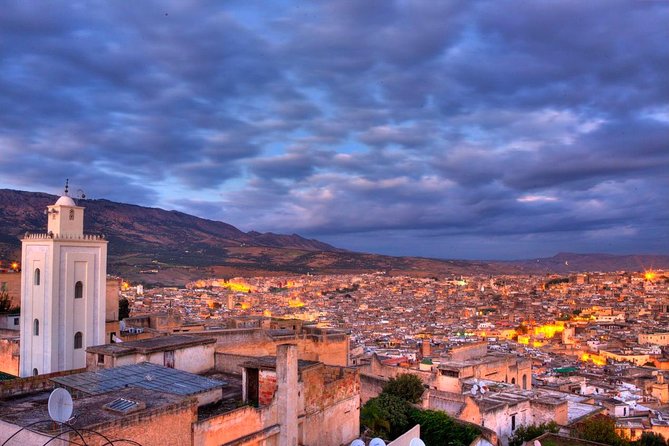
Fez is easiest to understand on foot, one twisting lane at a time. This private tour takes you from the Royal Palace gates and the old Jewish quarter into Fes el-Bali, where madrasas, museums, mosques, workshops, and tanneries fill a medieval street plan.
I like the private format, since you can ask questions, slow down for photographs, or shift the route toward crafts and local history. I also like the useful orientation for a first visit, especially with guides such as Hassan, Rachid, and Kamal noted for patience, local insight, and adapting the walk to personal interests.
The main caution is the tour length and walking surface. The experience is advertised as both five and six hours, and the Medina means uneven lanes, crowds, stairs, and little shade. You should also confirm which admission fees are covered before setting out.
Key details to know before you book
- A private walk through both Fes el-Jdid and Fes el-Bali: You see the royal district, Mellah, and central Medina in one long outing.
- The route mixes major sights with local context: Royal gates, Jewish heritage, Islamic schools, woodcraft, scholarship, and leather production all have a place.
- Guides can adjust the pace and focus: Hassan changed his route for a photography-focused guest, while Rachid and Kamal provided personal, attentive guiding.
- Chouara Tannery is a full sensory stop: The colored dye pits are striking, but the smell is strong and mint may be offered.
- The price is modest for a private half-day: At $30 per person, value is strongest for pairs, families, or small groups.
- Plan for a real walking day: A moderate fitness level is required, and the tour operates in all weather.
Why a private walk helps in Fez
Fez is not a city I would tackle casually on my first morning. The Medina has thousands of lanes, many too narrow for cars, and the route can feel confusing even when you know the general direction. A local guide gives you a working map in your head: which gate leads where, how the old quarters fit together, and why one street is devoted to a particular craft.
The private setup matters more here than it would on a simple city-center stroll. You can ask about architecture, religion, trade, or daily life without waiting for a group to catch up. If photography is your priority, you can pause. If you care more about history than shopping, you can say so clearly.
That flexibility is not just a comfort. It can shape the day. Hassan adjusted his route for a guest seeking local photography rather than a standard circuit. Rachid directed a guest to local craft workshops and less familiar corners, while Kamal met a guest at Fez station and guided a relaxed six-hour visit. Guide assignments are not guaranteed, but these examples show the kind of personal approach you should request when booking.
The price is $30 per person, a strong figure if two or more people share the experience and you want a private guide rather than a large group. The value depends partly on admissions, since the general details say entrance fees are not included, while individual stops identify some tickets as included. Ask for a clear list before you pay for any site.
More Walking Tours in Fez
- Explore Fes: Unforgettable Guided Walking Tour of the Medina
★ 4.7 · 1,339 reviews - Exclusive Fez Medina Walking Tour with Private Guide
★ 5.0 · 392 reviews - Fez: Guided Walking Tour of the Historic Medina
★ 5.0 · 359 reviews
From the Royal Palace to the old Mellah
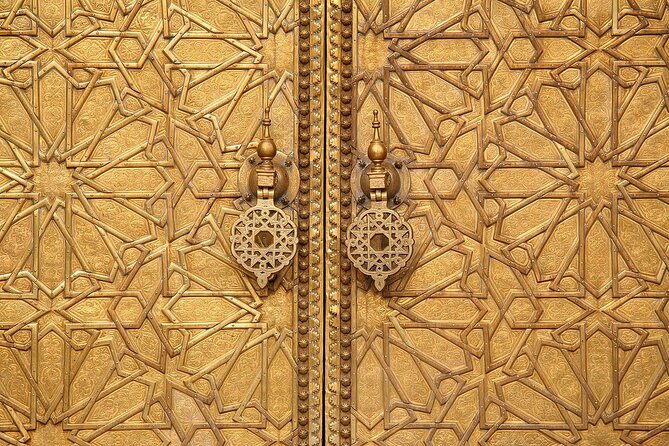
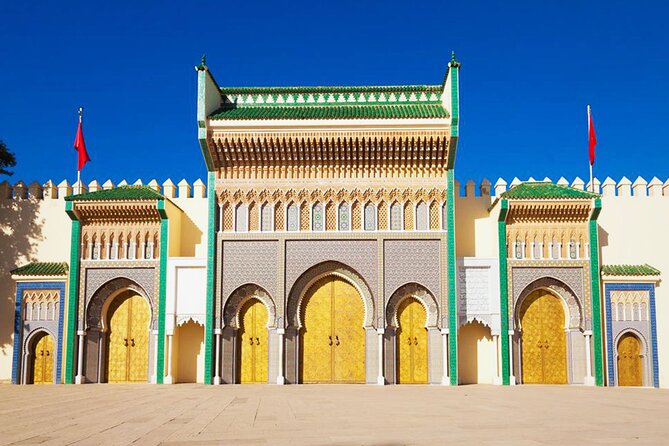
The walk begins near the Royal Palace of Fez, also called Dar el-Makhzen, in Fes el-Jdid. You cannot tour the working palace itself, so this is an exterior stop lasting about 15 minutes. The reward is the grand façade, especially the gold-colored bronze gates with zellij tilework, carved cedar, and stucco decoration.
These gates are among Fez’s easiest architectural introductions. They show the care given to pattern, proportion, and surface detail in Moroccan design, even though the royal complex beyond them remains closed. Your guide can also place the palace in the story of Fes el-Jdid, the newer royal city created during the Marinid period.
Next comes the Mellah, Fez’s historic Jewish quarter. The planned neighborhood grew beside the palace in the 15th century, giving the Jewish community a close connection to royal trade and administration while also separating it from Muslim quarters.
Allow about an hour here. That is enough time to look at the outward-facing wooden balconies, which differ from the inward-looking homes common in many Muslim neighborhoods. The change in building style gives you a visible clue that Fez was shaped by more than one religious and cultural tradition.
The Ibn Danan Synagogue and Jewish Cemetery are key parts of the quarter. The synagogue dates from the 17th century, and the cemetery contains tombs oriented toward Jerusalem. Most Jewish residents left after the 20th century, but the quarter still helps explain the city’s trade networks, crafts, and changing population.
I find this stop especially useful because it keeps the tour from becoming a parade of Islamic monuments alone. It adds social history to the architecture. The lanes can feel weathered rather than polished, which is part of the point, but visitors looking only for grand façades may find the hour slower and more reflective.
Entering Fes el-Bali through Bab Boujloud
Bab Boujloud is the famous western gateway into the UNESCO-listed Fes el-Bali Medina. The gate you see today dates from 1913, so it is not a medieval structure in the strict sense. Its design borrows heavily from Moroccan forms, with blue zellij on the outer face, green tile on the inner side, geometric pattern, and three horseshoe arches.
The color change has meaning. Blue is associated with Fez, while green carries Islamic associations. Your guide can help you read the gate as more than a pretty photo stop: it is a modern entrance built in a traditional style, linking the newer city to the old one.
From here, the route turns into narrower lanes. This is where a private guide earns much of the fee. You can stop to get your bearings, ask about a doorway or shopfront, and learn how to recognize the main route back to Bab Boujloud.
Expect a lot of walking rather than a series of short transfers. Fez’s old streets are part of the experience, but they are also tiring. Wear shoes with a firm sole, keep your hands free, and dress for the weather. The tour runs in rain or sun, so a light layer and modest clothing are sensible choices.
Bou Inania Medersa, a rare religious interior
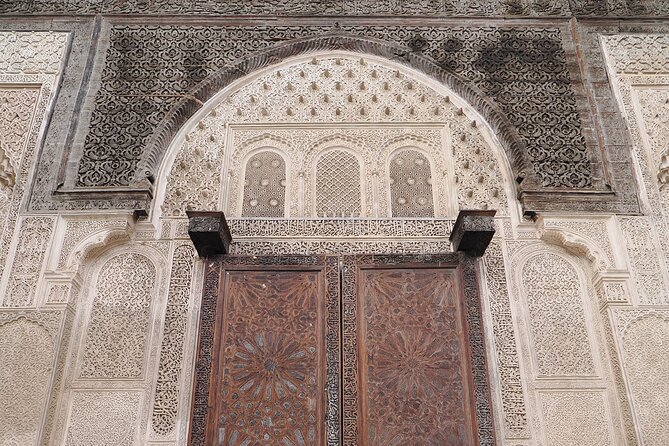
The Bou Inania Medersa is one of the most rewarding stops because non-Muslims can enter this religious site. Built between 1351 and 1356 by Marinid Sultan Abu Inan Faris, it served as both a theological college and a mosque.
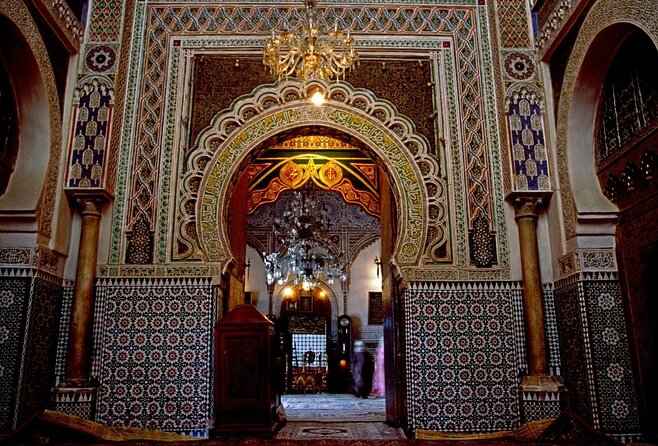
You get about 30 minutes inside. The central courtyard brings together the main decorative arts of Fez: zellij mosaic, carved cedar, sculpted stucco, Quranic calligraphy, and a marble ablution fountain. Look upward and you will see how the details work together rather than appearing as separate decorations.
The green-tiled minaret is another notable feature. Inside, the prayer hall includes a mihrab with gold leaf. The building’s purpose is important to remember. This was not simply a palace or showpiece. Students studied Islamic law, theology, and related subjects here, and the design supported both learning and worship.
I would ask your guide to explain what you are seeing before rushing to photographs. The courtyard is compact, and the fine work rewards a slow look. Since admission is identified as included for this stop, it is one of the places where you should receive clear value from the tour.
A few other Fez days worth comparing
- Fez Medina Guided Tour
★ 4.6 · 2,079 reviews - Fes: Museum, Al Attarine Madrasa & Tannery and Medina Tour
★ 4.6 · 1,655 reviews - Fes: Royal Palace, Madrasa, Tannery & Souks and Medina Tour
★ 4.5 · 508 reviews - Fez Medina 4-Hour Guided Walking Tour
★ 4.5 · 248 reviews
Nejjarine Museum and the story of woodcraft
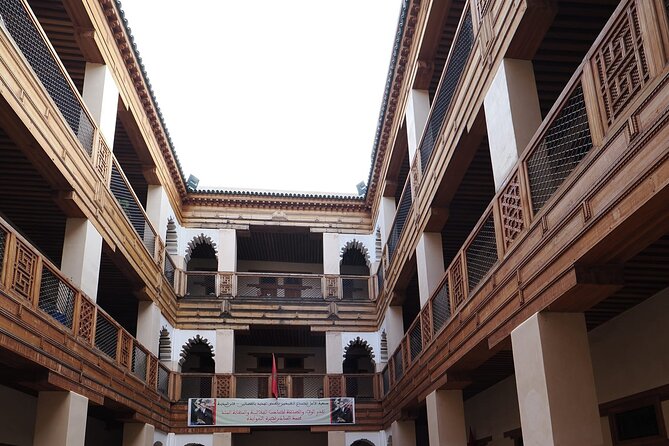
The Nejjarine Museum occupies an 18th-century funduq, or caravanserai, once used by merchants and their animals during visits to Fez. The building was restored and opened as a museum in 1998, giving you a chance to see how a trade stop could be adapted for modern cultural use.
Plan on about an hour. The displays focus on Moroccan woodcraft, with traditional tools, furniture, and musical instruments. That collection gives useful background for the carved cedar ceilings and doors you have already seen at the palace gates and medersa.
The courtyard is a highlight in its own right. Andalusian-style decoration, zellij, carved wood, and a marble fountain turn a functional commercial building into a carefully finished interior. If you are interested in how objects were made rather than simply buying them in a shop, this is one of the tour’s better stops.
The rooftop terrace offers views over the Medina. It gives your legs a break and helps you understand the density of Fez from above. The museum is listed with admission included, though the overall tour terms say entrance fees are not included, so confirm the current arrangement.
Al Quaraouiyine and Fez as a center of learning
The Mosque and University of al-Qarawiyyin receives a short 15-minute visit. Founded in 859 by Fatima al-Fihri, it is recognized as the oldest existing degree-granting university in the world by UNESCO and Guinness World Records.
The complex remains a functioning mosque and university. That means your access may be limited, and you should treat the site as a place of worship and study rather than a standard museum. The tour description identifies admission as free.
Your guide can point out the courtyard, hypostyle prayer hall, carved cedar, stucco work, and green-tiled minaret, though the brief stop will not allow a full architectural study. The library holds old manuscripts, including 9th-century Qurans, but do not assume you will enter every part of the complex.
This stop is valuable for the wider story it tells. Fez was not only a place of commerce and skilled production. It also drew scholars to study theology, law, astronomy, and languages. That intellectual role helps explain why the city became one of Morocco’s major cultural centers.
Chouara Tannery and the strongest sensory stop
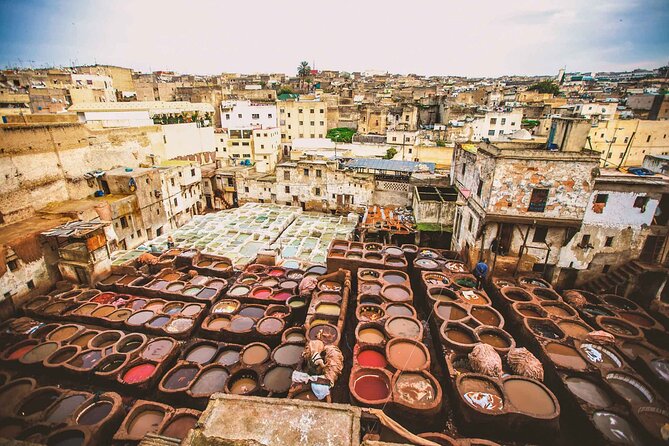
The final major stop is Chouara Tannery, where leather has been processed since the 11th-century Almoravid period. From surrounding terraces, you look down on stone dyeing vats arranged in a honeycomb pattern.
Workers treat hides with traditional methods and natural dyes. Saffron produces yellow, poppy gives red, and indigo creates blue. Pigeon dung is used to soften hides, a detail that explains the powerful smell as well as the old production method.
Mint sprigs may be offered to help with the odor. Take them, but do not expect the mint to erase the experience. Chouara is visually impressive and physically intense. The smell, heat, and working conditions can be difficult for some people, especially after several hours on foot.
You will normally view the tannery from above rather than walk through the dye pits. From the terrace, you can watch an old craft process while seeing leather goods sold nearby. If shopping interests you, tell your guide what you want and how much time you are willing to spend. A private tour gives you more room to set those limits.
This stop can also feel commercial, since terraces often connect with leather shops. That does not make the craft less real, but you should understand the setting and avoid assuming that every purchase is required. You are paying for the walk and guide, not for a shop visit.
Timing, fitness, and what to bring
The title describes a five-hour tour, while the fuller description calls it six hours and the planned stops add up to roughly four hours and 45 minutes before walking between them. Treat this as a half-day outing with a flexible finish, and confirm the expected duration with Bouaouina Private Tours.
The activity requires moderate physical fitness. You will walk for hours over old lanes, and the route may include steps and uneven paving. Children must be accompanied by an adult. Service animals are allowed, and the route is near public transportation, with pickup offered.
I would bring:
- Comfortable walking shoes with good grip
- Water and a small snack, since food and drinks are not included
- Sun protection or rain protection, depending on the forecast
- A phone or camera, especially if photography is a priority
- Modest clothing suitable for historic religious areas
- A small amount of flexibility in your schedule
The guide may be multilingual. If language is important to you, request your preferred language when arranging the tour, but do not assume a particular guide will be assigned.
Who will get the most from this tour
I would choose this experience for a first visit to Fez, especially if you want an introduction before exploring alone. It combines orientation with major sights, so you learn the basic shape of the city while seeing places you might otherwise miss.
It also suits photographers and craft enthusiasts. Hassan’s route adjustment shows why a private format can help someone who wants less time at standard landmarks and more time in local lanes or workshops. Rachid’s focus on craft spaces points to another useful option: tell your guide early if you want artisans, architecture, religious history, or photography to lead the day.
Families can book it, provided children are accompanied by an adult and can manage the walking. Older visitors or anyone with mobility limits should think carefully about the surface and duration before reserving.
I would be less likely to recommend it if you dislike long walks, strong smells, or flexible timing. The Medina is not a neat open-air museum. It is a working part of Fez, and that means noise, narrow passages, commercial stops, and a pace shaped by the city rather than by a smooth sightseeing loop.
Should you book the Fez Medina walk?
At $30 per person, this is a good-value choice for a private introduction to Fez, provided you confirm the five-hour versus six-hour timing and the admission-fee policy. The route covers an unusually broad set of themes: royal power, Jewish life, Islamic education, woodcraft, scholarship, and leather production.
Book it if you want help finding your way, prefer a guide who can adjust the day, and have the stamina for a long walk. Ask for a guide suited to your language and interests, mention photography or craft workshops before the tour starts, and set clear boundaries around shopping.
Skip it if you want a short, low-effort city tour or guaranteed access to every part of al-Qarawiyyine and the Royal Palace. For most first-time visitors who want context as well as sights, this private walk offers a useful and fairly priced start to Fez.
FAQ
How long does the tour last?
The experience is described as approximately five hours in the title and about six hours in the fuller tour description. Confirm the expected duration with the provider before booking.
Is this a private tour?
Yes. Only your group participates, and a local guide is included.
What is included in the price?
A local guide and private tour are included. Food and drinks are not included.
Are entrance fees included?
The general information says entrance fees are not included, but individual stops identify Bou Inania Medersa and Nejjarine Museum as including admission. Confirm the current admission policy before the tour.
Is pickup available?
Pickup is offered, and the experience is near public transportation.
Does the tour visit the Royal Palace interior?
No interior access is stated. The Royal Palace stop focuses on the exterior gates, and the palace remains a functioning royal residence closed to the public.
Can children join the tour?
Yes, but children must be accompanied by an adult.
What level of fitness is needed?
A moderate level of physical fitness is recommended. Expect several hours of walking through old Medina lanes, with uneven surfaces and possible steps.
Can I cancel for a refund?
Yes. You can cancel at least 24 hours before the local start time for a full refund. Cancellations or changes made less than 24 hours in advance are not refunded or accepted.
Just listed out of Fez
- Full-Day Tour from Fez to Vollubulis, Moulay Idriss Zerhoun, Mèknes★ 5.0 · 32 reviews
- Fez medina and it’s secrets : cultural tour (private)★ 5.0 · 32 reviews
- Friend tour guide to Fes Medina private walking tour★ 4.9 · 32 reviews
- From Fes: 2-Day Merzouga Desert Trip(Luxury Tent & Dinner)★ 4.8 · 32 reviews
- Fez guided Tour with a Local Guide★ 5.0 · 32 reviews
- Fez Cooking Class★ 5.0 · 33 reviews
- Fez Street Food Tour★ 4.5 · 33 reviews
- Discover Fes: Culture, handicraft & Hidden Treasures★ 5.0 · 33 reviews
Fez Tours, compared.
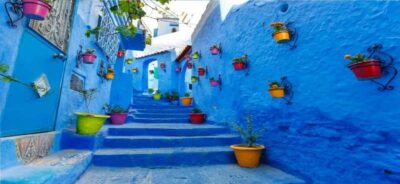
Chefchaouen Day Trip from Fez (Shared Group Tour)
Read our review →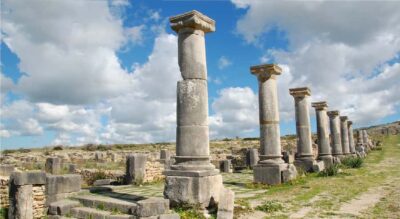
Volubilis Roman Ruins, Mouly Idriss, & Meknes Day Trip
Read our review →
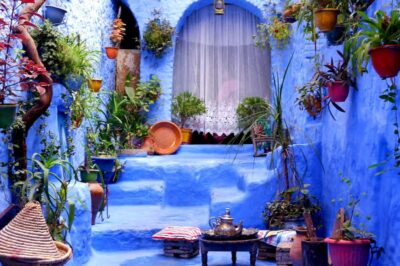
Blue City magic: Affordable Day Trip from Fez to Chefchaouen
Read our review →
Sahara Desert 2-Day Tour with Merzouga Camp Stay
Read our review →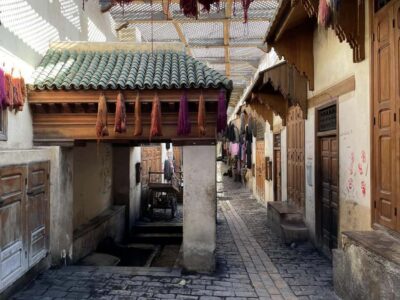
Museum, Al Attarine Madrasa & Tannery and Medina Tour
Read our review →
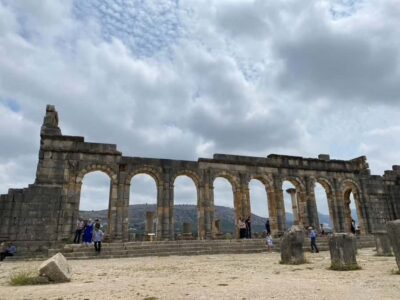
Volubilis, Moulay Idriss, & Meknes Full-Day Trip
Read our review →Browse the lists this tour appears in